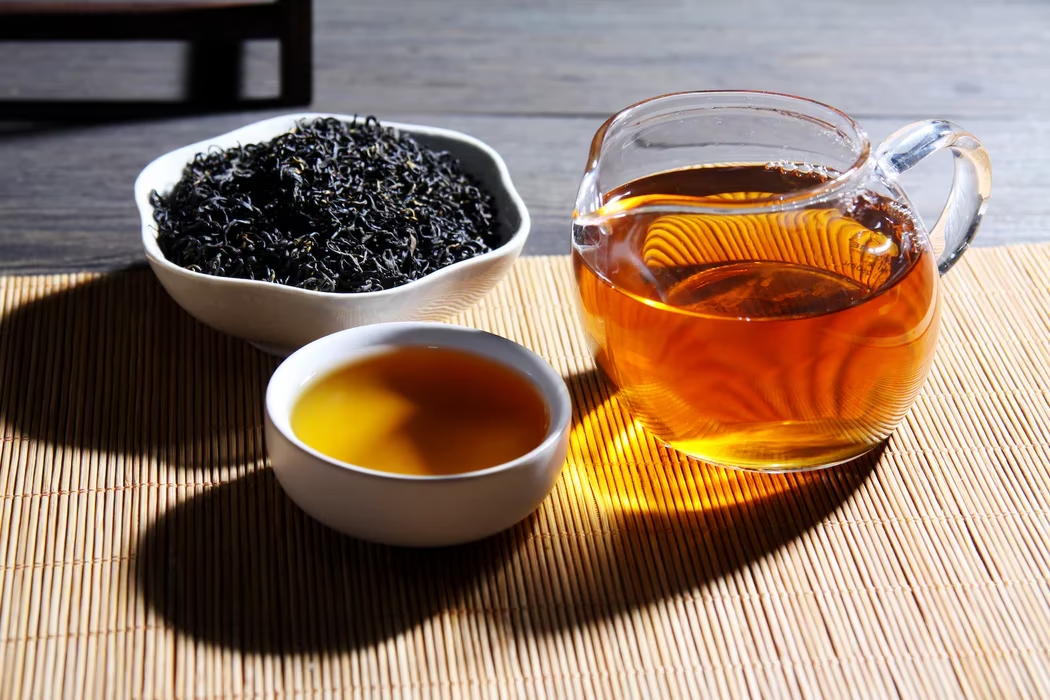
Keemun is one of the most famous black teas in the world, and one of the least known by name. It has been a core ingredient in English Breakfast and Russian Caravan blends for over a century, shaping the flavour of the tea most Westerners drink without them ever hearing its name.
The word is an anglicization of Qimen, a county in southern Anhui where the tea has been made since the 1870s. In China it is still called Qimen hongcha — Qimen red tea. Under either name, it is one of the most refined black teas in existence.
How It Began
The story usually starts with a man named Yu Ganchen, a Qing dynasty official who travelled to Fujian in the 1870s to learn how to make black tea. Qimen at the time was producing green tea but struggling in the market. Yu brought the technique home, adapted it to local leaves, and within a few years Keemun was being exported to Europe.
By the 1890s, Keemun was established as one of the prestige teas of the British and European market. It was served at royal courts. It became the core of the classic English Breakfast blend, alongside Assam and Ceylon. For a century, most of what people in London drank at breakfast contained Keemun.
What It Tastes Like
A well-made Keemun is immediately distinctive. The dry leaves are thin, twisted, and uniformly dark, sometimes with a golden tint where the tips show through. The brewed tea is deep amber-red, and the aroma is what Western tea writers sometimes call "Keemun character" — a warm, sweet, slightly smoky note with undertones of cocoa, orchid, or dried fruit.
On the palate, it is medium-bodied, sweet, with a soft texture and a finish that is both smoky and honeyed. The tea is less astringent than most black teas and more complex in flavour. It is almost perfumed in the best sense — not artificial, but deeply aromatic.
Grades matter. Keemun Mao Feng is the highest, made from young leaves and tips. Keemun Hao Ya A and B come next. Standard Keemun Gong Fu is the classic grade, sold loose and used in blends. The higher grades have more of the signature character; lower grades are more of a generic black tea.
A Note on What You Are Buying
Much of what is sold as "Keemun" in the West is low-grade tea — often not even from Qimen — that has been given the name for marketing. Real Keemun Mao Feng or Hao Ya is a specific product from a specific county, and it costs meaningfully more than generic black tea.
If you want to taste what Keemun actually is, buy from a specialist tea shop and ask for a named grade. The difference is substantial. A good Keemun Mao Feng, brewed correctly, is one of the most pleasant black teas you can drink — and it makes the supermarket version taste like something else entirely.
How to Brew Keemun
Keemun is among the black teas that benefit most from gongfu brewing. The Western method — a large pot, a single long infusion — works, but it flattens the tea's layers.
For gongfu: 4 to 5 grams in a 100ml gaiwan, water at 95°C to 100°C, first infusion 10 seconds. The tea will give 5 to 7 good infusions, with the character evolving noticeably between them. Early infusions are bright and floral; middle ones bring out the cocoa and honey; later ones are thinner but sweeter.
For Western brewing: 3 grams per 200ml of water, 3 minutes. Do not add milk unless you know you like it — Keemun is one of the black teas worth drinking plain, and the cocoa and floral notes are lost under dairy.