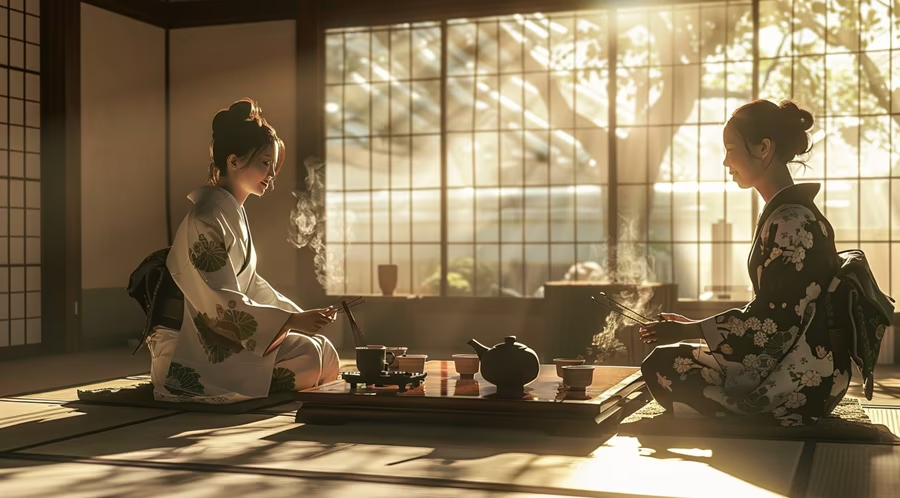
The Japanese tea ceremony — chanoyu, "hot water for tea," or sado, "the way of tea" — is the most thoroughly developed tea tradition in the world. It has been formalized, refined, and passed down for over four hundred years. Every movement is prescribed. Every object has a history. A single formal ceremony can last four hours, and some tea schools still teach the same sequences of gestures taught to apprentices in the 16th century.
What happens in those four hours is, practically speaking, simple. The host prepares a bowl of matcha and serves it to one or a few guests. But the simplicity is deliberate. Chanoyu is an art form built around the proposition that if you slow down enough, and pay enough attention, the preparation and drinking of a single bowl of tea becomes a complete experience.
Where It Came From
Matcha came to Japan from China in the 12th century, brought back by Buddhist monks. At first it was used mainly by temples, as a way to stay alert during meditation. Over the next few centuries the practice spread to samurai elites and then to urban merchants.
The defining figure is Sen no Rikyu (1522-1591), a merchant who served as tea master to the warlord Toyotomi Hideyoshi. Rikyu codified the aesthetic principles that still define chanoyu: wabi-sabi (beauty in imperfection), simplicity, rustic calm. His disciples founded the three main schools of tea — Omotesenke, Urasenke, and Mushakoji-senke — which still operate today.
Rikyu's death was ordered by Hideyoshi in a disagreement whose exact cause remains unclear. He was required to commit ritual suicide. His descendants continued to teach, and the tradition survived.
What Happens in a Ceremony
A formal ceremony begins before you even arrive. Guests are expected to arrive at a specific time, dressed simply, bringing nothing. You are shown to a waiting room, then walked through a garden path to the tea room. The path (roji) is meant to leave behind the outside world.
The tea room (chashitsu) is small, traditionally four-and-a-half tatami mats, with a low entrance (nijiriguchi) through which everyone must enter bent over. The small entrance equalizes all guests: whether you are a samurai or a merchant, you must bow to enter. Inside, the room is austere. A single hanging scroll, a single flower arrangement, a fire in the hearth.
The host performs a precise sequence of movements to prepare the tea. Every utensil is handled in a specific way. Water is heated in a kettle over charcoal. The matcha is whisked into a bowl, offered to the guest, received with both hands. The guest rotates the bowl, admires it briefly, drinks in three sips, wipes the rim, returns the bowl with proper gestures.
Between sections, there is food — a small meal (kaiseki), sweets, and two kinds of tea, thick (koicha) and thin (usucha). A full formal ceremony is a significant event.
The Four Principles
Rikyu is said to have summarized chanoyu with four principles: wa, kei, sei, jaku. Harmony, respect, purity, tranquility.
Harmony refers to the relationship between host, guest, and environment. Every object in the tea room is chosen for the specific occasion, and the ceremony should feel inevitable — as if this particular gathering, this particular light, this particular tea, all belong together.
Respect is mutual. The host treats the guest with great attention; the guest honours the host's preparation. The small entrance is one expression of this. So is the rotation of the bowl — you turn the decorated front of the bowl toward the host, not yourself, as a gesture of humility.
Purity refers partly to physical cleanliness (utensils are meticulously wiped), partly to inner purity — leaving behind the concerns of the outside world upon entering.
Tranquility is what the first three principles produce. A well-executed ceremony creates a specific kind of calm, different from other forms of calm. For many practitioners, this is the point of chanoyu.
Attending a Ceremony
Tea ceremonies can be attended by visitors in many Japanese cities. The Urasenke school, one of the three main lineages, has international branches and offers public ceremonies. Shorter, less formal presentations (often 45 minutes to an hour) are offered at temples and cultural centres.
A serious, full-length formal ceremony is rarer and usually requires an invitation or advance arrangement. Some hotels in Kyoto offer high-quality ceremonies for travellers; a few temples (Daitoku-ji among them) do as well.
If you go: wear plain, modest clothes. Remove watches and jewellery. Do not bring anything with a strong smell. Accept what is offered without preference. Ask questions if you are invited to, but follow the host's cues — silence is often appropriate.
What you are likely to experience, especially the first time: a heightened awareness of small things. The sound of water. The weight of the bowl. The light on the scroll. The ceremony is designed to make these things noticeable, and for most people, at least some of that design still works.