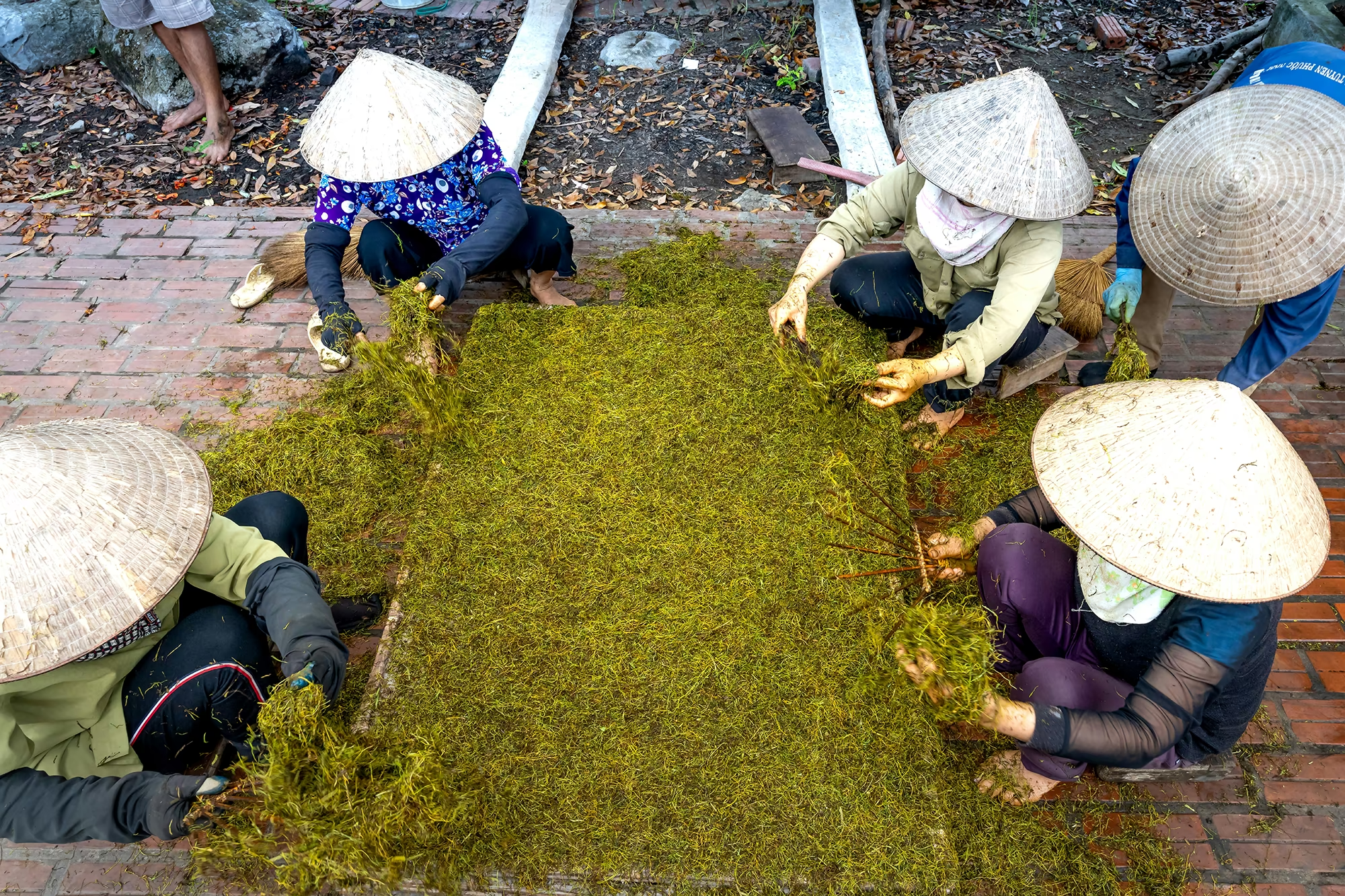
Green tea processing is the simplest of all tea processing — which is precisely why the details matter so much. There is no long oxidation, no complex fermentation, no months-long drying. The tea is picked, heated, shaped, and dried. Four steps. Each one is short. But within those four steps there is enormous variation, and most of what distinguishes a $200 Longjing from a supermarket green is decided there.
Step One: Withering
After picking, the leaves are usually laid out to wilt for a few hours. This is a light wither — nothing like the long withering used for white or oolong teas. Its purpose is to reduce the water content a little and soften the leaves so that they can be worked without breaking.
For some green teas, this step is skipped entirely and the leaves go straight from the basket to the firing wok. For others, it might be a few hours in the shade. It is the first point where tradition matters: each famous tea has its own established practice.
Step Two: Kill-Green (Fixing)
This is the central step. The leaves are exposed to heat to deactivate the enzymes that would otherwise oxidize them. The Chinese term is sha qing, "kill the green," though what it actually kills is the oxidation potential.
In China, kill-green is usually done by pan-firing. The leaves are placed in a large, shallow iron pan — a wok — heated to somewhere between 200°C and 300°C. The tea master works them by hand, pressing, turning, lifting. Depending on the tea, this can last a few minutes (for delicate greens) to a quarter of an hour (for sturdier ones).
In Japan, kill-green is done by steaming. The leaves pass through steam tunnels for 30 seconds to two minutes. Longer steaming produces darker-green, more pulverized tea; shorter steaming, a brighter, livelier leaf. The difference is the single most important factor in what distinguishes grades and styles of Japanese green.
Step Three: Rolling and Shaping
After fixing, the leaves are shaped. This step varies wildly between teas — it is what gives each type its characteristic look. Longjing is pressed flat against the pan. Bi Luo Chun is rolled into spirals. Mao Feng is twisted into slender needles. Japanese sencha is rolled and pressed into long dark needles by machines that mimic the hand motions once used for it.
Rolling serves two purposes. It shapes the finished tea for recognition and sale. And, more importantly, it breaks open some of the cells in the leaf, releasing the aromatic compounds that the water will later extract. A well-rolled tea brews more flavourfully than an un-rolled one, because the water has more surface to work on.
Step Four: Drying
Finally the tea is dried down to a storage-stable moisture content — usually around 3 percent. Drying is done in ovens, in the same pans used for firing, in the sun, or in mechanical dryers. It usually takes several rounds.
Drying is also the last chance to influence flavour. A little extra firing at this stage adds a toasty, roasted note to the tea. Less firing leaves it greener and fresher-tasting. For teas like Longjing the final pan-finish is part of what defines the style — it is what gives the tea its chestnut sweetness.
The Principle
The principle behind green tea processing is preservation. Unlike the other categories — oolong, black, white, pu-erh — green tea does not try to transform the leaf through fermentation, long oxidation, or aging. It tries to keep the leaf close to what it was when it came off the plant. Every step is, in one sense, defensive: don't let the oxidation happen, don't let the leaves break, don't let the moisture get in.
This is why freshness matters so much for green tea, and why every famous green tea has a specific region, a specific season, a specific method. The processing is trying to hold on to something that is inherently unstable. The fresher and better the original leaf, the better the finished tea — and the less time it has before it begins, inevitably, to fade.