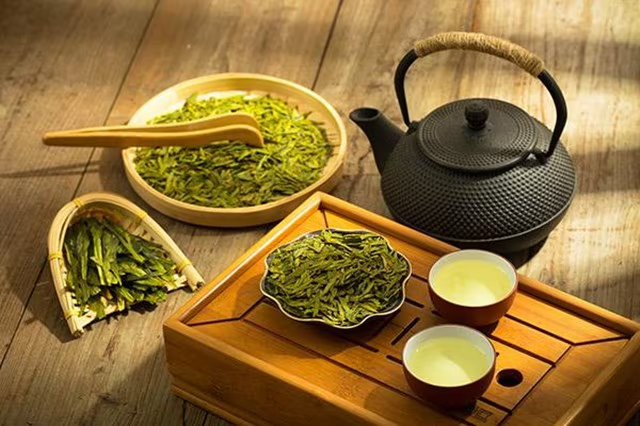
There are Chinese teas with more history, teas with deeper flavour, and teas with rarer terroir. But when a Chinese person says lü cha — green tea — the image that usually comes to mind is Longjing. Flat, jade-coloured leaves that look as if they've been pressed between the pages of a book. A warm chestnut aroma rising from the cup. A taste that somehow holds together sweetness, grassiness, and something almost savoury, all at once.
The name means "Dragon Well," after a spring near the village where the tea has been made for centuries. That spring, the surrounding hills, and the way the leaves are processed by hand in hot iron woks — this is what makes Longjing what it is. Not a variety of tea, exactly, but a way of doing one particular thing extraordinarily well.
Where It Comes From
Longjing is grown in Zhejiang Province, in the hills immediately west of Hangzhou — the city that Marco Polo called "the finest and noblest in the world." The tea takes its name from the Dragon Well spring in Longjing Village, but the growing area extends across a patchwork of small villages: Shifeng, Meijiawu, Weng Jia Shan, and others. Each has a slightly different reputation, a slightly different style.
The most prized Longjing is called Xihu Longjing, or West Lake Longjing. The name is protected — officially, only tea grown within a defined zone around West Lake can carry it. Beyond that zone, tea made in the same style is sold as Zhejiang Longjing or simply Longjing, without the West Lake designation. The difference in price can be tenfold. Whether the difference in the cup justifies it is a question tea drinkers have been arguing about for a long time.
How It Is Made
What makes Longjing Longjing is the pan-roasting. After the leaves are plucked — usually just a bud and one young leaf — they are left to wither briefly, then placed into a hot wok. From there, it is all hands. The tea master presses the leaves flat against the curved iron surface, turns them, lifts them, presses again. The movements have names: grabbing, shaking, throwing, swinging, pressing, pushing, buckling, grinding, tossing, and smoothing. Ten motions, performed in sequence, some of them dozens of times per batch.
The heat dries the tea and stops the oxidation that would turn it into a different kind of tea altogether. But the pressing is what gives Longjing its signature shape. The flat, smooth, almost blade-like form is not decorative. It comes from force, repeated for the time it takes to get a small batch of leaves to the right level of dryness and flavour.
Good Longjing is still made entirely by hand. Machine-processed Longjing exists and is perfectly drinkable, but the best tea — the kind with the clearest flavour and the most even leaves — comes from a master at a wok.
What It Tastes Like
A well-made Longjing has a layered flavour that unfolds as you drink. The first sip is often sweet — li xiang, the "chestnut aroma," is the classic description, though some people find it closer to roasted pumpkin seeds or fresh peas. Underneath that is a green note, sometimes grassy, sometimes more like fresh soybeans. And there is a faint savoury quality — umami, if you want the Japanese term — that gives the tea body it would otherwise lack.
The finish is where Longjing reveals its quality. Good leaves leave a clean, slightly sweet aftertaste on the tongue that lasts a surprisingly long time. The Chinese term for this is huigan, "returning sweetness," and it is one of the main ways tea drinkers judge green tea.
How to Brew It
Longjing is not a forgiving tea. Water that is too hot will make it bitter and dull the delicate aromas. Water that is too cool will leave the flavour flat.
The standard approach is a tall glass or a small gaiwan, about 3 grams of leaf per 150 millilitres of water, water at 80°C — not boiling. Pour the water over the leaves and wait about 90 seconds for the first infusion. Good Longjing will infuse three or four times, each infusion a little different from the last.
Many Chinese tea drinkers brew Longjing in a glass because watching the leaves unfold is part of the experience. They sink, rise, sink again — a kind of slow visual prelude to drinking. If you're using a gaiwan, the gongfu approach works, but with shorter infusions than you'd use for a sturdier tea.
How to Tell Good from Ordinary
Longjing is one of the most counterfeited teas in China. Tea from other provinces is regularly sold as West Lake Longjing, and even within Hangzhou there is significant variation in quality. A few things to look for, in roughly descending order of reliability:
The leaf shape. Good Longjing is flat, smooth, and relatively uniform. Broken leaves, curled edges, or uneven colour all point to lower quality or machine processing.
The colour. Fresh Longjing should be a pale jade green, slightly yellow in the warmest light, never brown or grey. An older tea will fade toward yellow; that is not a defect, but it is a sign the tea is past its prime.
The aroma of the dry leaf. Good Longjing has a clear, slightly toasty, vegetal smell before you even add water. If the dry leaf smells of nothing, the brewed tea will not surprise you either.
Harvest date. Longjing has a short window. The most prized tea, Ming Qian, is picked before the Qingming Festival in early April. The next grade, Yu Qian, is picked before Guyu in late April. After that, the quality drops off sharply. Longjing is meant to be drunk young, ideally within a year of harvest.
Longjing in Chinese Tea Culture
Longjing is one of China's Ten Famous Teas, a semi-official list that has existed in various forms for centuries. In most versions of the list, it sits at or near the top. It has been a tribute tea — a tea sent to the emperor — since the Qing dynasty. The Kangxi and Qianlong emperors both wrote poems about it. Mao Zedong drank it. Chinese presidents still serve it to visiting heads of state.
None of this is why it's worth drinking. Longjing is worth drinking because a good cup of it is a complete experience — a tea that holds up to attention, rewards careful brewing, and still gives you something if you just throw leaves into a thermos at eight in the morning. That range is unusual. Most great teas demand that you meet them on their terms. Longjing, on its best days, meets you on yours.