In a valley in the Wuyi Mountains of northern Fujian, growing out of a rock face, there are six small tea bushes. They are the original Da Hong Pao — the Big Red Robe — and they are reportedly around 350 years old. They are guarded by the Chinese government. They have not been harvested for commercial tea in decades.
Every Da Hong Pao you can buy today is something else: tea from younger plants, often grown elsewhere, sometimes blended from multiple Wuyi varietals to approximate the original flavour. This does not mean it is fake. It means that the name Da Hong Pao now refers to a style of tea as much as to a specific cultivar. And the style is one of the most remarkable things you can put in your mouth.
Wuyi Mountains: Where Tea Grows on Rock
The Wuyi Mountains are a UNESCO World Heritage Site in northern Fujian, a landscape of narrow gorges, sheer cliffs, and winding streams. Tea has been grown here for over a thousand years, and the best Wuyi tea is still grown the old way: in small plots tucked between the cliffs, where mineral-rich soil and the distinctive microclimate produce a tea flavour found nowhere else.
The Chinese term for this style is yan cha — "rock tea." The word yan yun, "rock rhyme," refers to a particular mineral quality that the best Wuyi teas have. It is hard to describe until you have tasted it. A faint wet-stone note, sometimes like a riverbed, sometimes like warm slate in sun. It is unmistakable when it is there.
How Da Hong Pao Tastes
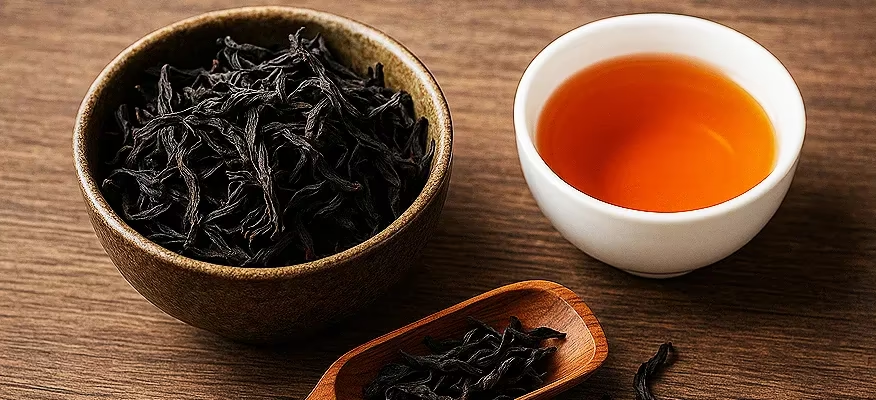
A well-made Da Hong Pao pours a dark amber. The aroma is rich and roasted — cocoa, dried stone fruit, sometimes a faint note of almonds. The taste is full-bodied but not heavy: warm, roasted, with layers of complexity that unfold across multiple infusions.
The characteristic rock rhyme appears mid-palate and in the finish. After swallowing, there is often a long, slightly sweet aftertaste — the huigan, returning sweetness — that can last minutes. Good Da Hong Pao is a tea that stays with you.
The roasting is the key to the style. It is done in stages, over weeks, using bamboo baskets and charcoal. The master adjusts the temperature and duration to match the specific leaves. A heavy roast produces a dark, coffee-like tea. A lighter roast lets more of the original floral notes through. Neither is wrong; they are different answers to what the leaf can become.
Pure Cultivar vs Commercial Da Hong Pao
The original mother trees produce a varietal sometimes called Beidou or Queshe. Tea made from direct cuttings of these trees is known as chun zhong, pure-cultivar Da Hong Pao, and it is expensive and rare.
Most Da Hong Pao on the market is a blended tea — a combination of several Wuyi cultivars roasted in the traditional Da Hong Pao style. This is not a deception. The blending is done deliberately, and a well-blended commercial Da Hong Pao can be an excellent tea. What you are paying for is the style and the craftsmanship, not the specific bushes.
At the highest end, single-origin teas from named cliffs — Da Keng Kou, Niu Lan Keng, others — are sold to serious collectors. These are among the most expensive teas in the world. A good commercial Da Hong Pao costs a reasonable amount; a top single-origin can cost as much as a good wine.
How to Brew It
Da Hong Pao wants hot water and short infusions. Use fully boiling water, 100°C. About 5 to 6 grams in a 100ml gaiwan or small Yixing teapot. Rinse the leaves with a quick 3-second infusion, then pour first proper infusion for 8 to 10 seconds.
A good Da Hong Pao will give 10 or more infusions. The first few are concentrated and roasted. By the middle infusions (4 to 7), the deeper flavours come through — stone fruit, cocoa, mineral. The later infusions get lighter, sweeter, with a clean return.
Do not overbrew. Rock teas become bitter quickly if steeped too long, and the subtle layers are lost. Short infusions, repeated often, are the way.