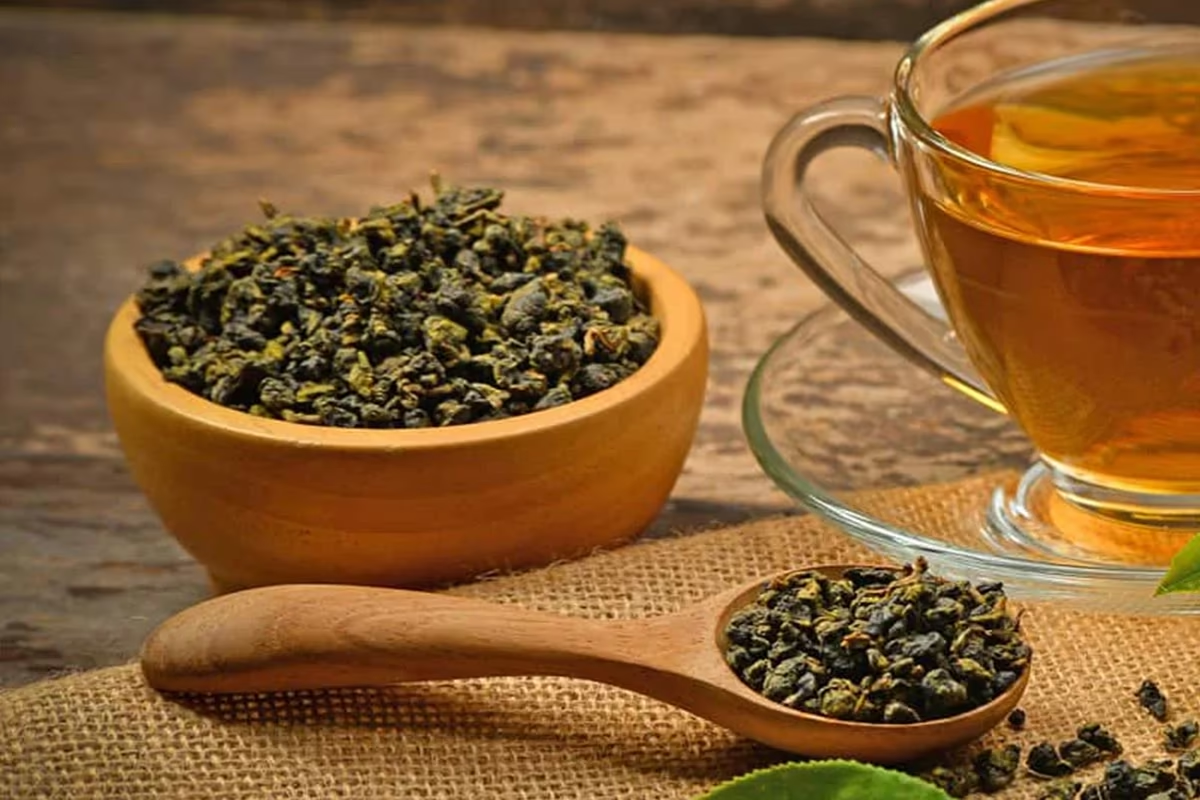
Tieguanyin — literally "Iron Goddess of Mercy" — is the most famous oolong in China. It has been made in Anxi county in southern Fujian for about three hundred years, and it has been competing with Longjing for the title of "best-known Chinese tea" for most of that time.
It is also a tea that has been pulled in two directions by modern markets, and a drinker encountering it for the first time may be confused about which version is the "real" one. The honest answer is that both are real. They just taste nothing alike.
The Legend and the Name
The most common story goes like this: a poor farmer named Wei, devoted to the bodhisattva Guanyin (the Goddess of Mercy), kept up a small ruined temple near his home. In a dream, the goddess showed him a tea plant hidden among the rocks. He found it, planted cuttings from it, and made an extraordinary tea. He named it for the goddess.
The tie ("iron") in the name is usually explained by the weight and density of the finished leaves — they are heavier than other teas of comparable volume — or by the dark iron colour of the traditionally roasted version. The name dates to the Qing dynasty, sometime in the 18th century.
The Modern Green Style
Walk into most tea shops today and ask for Tieguanyin and you will probably be given the modern style: bright green, tightly rolled into small balls, lightly oxidized (around 20 percent), minimally roasted. Brewed, it gives a pale golden liquor and an aroma dominated by orchid and lilac, with a sweet, clean, almost creamy finish.
This style emerged in the 1990s and 2000s, driven by Taiwanese influence on the Anxi market. Taiwanese oolong had popularized a lighter, greener style, and Anxi farmers adapted to meet demand. The result is, for better or worse, what most modern drinkers think of as Tieguanyin.
It is a beautiful tea when well-made. But it has almost nothing in common with what Tieguanyin was for the first 250 years of its existence.
The Traditional Roasted Style
Traditional Tieguanyin — nong xiang, "thick fragrance" — is more oxidized (around 40 to 50 percent) and much more roasted. The leaves are dark, almost black. Brewed, they produce a dark amber liquor and a flavour that is warm, nutty, full-bodied, with notes of dark fruit, caramel, and sometimes a faint smokiness from the roasting.
This is what Tieguanyin traditionally was, and what many serious tea drinkers prefer. It ages well — a well-made traditional Tieguanyin can improve for years in storage, developing deeper flavours. The modern green style, by contrast, is meant to be drunk fresh and loses character within a year.
The traditional style is harder to find outside of specialist shops. If you want to try it, ask specifically for "roasted" or "traditional" Tieguanyin, and be prepared for a tea that tastes almost nothing like the modern green version.
How to Brew It
Modern Tieguanyin: use water just off the boil, around 95°C. About 5 grams in a 100ml gaiwan. Very short first infusion — 10 to 15 seconds. Expect 6 to 8 good infusions from high-quality leaves. The tea will taste fresh and floral.
Traditional Tieguanyin: full boiling water, 100°C. Same leaf-to-water ratio. A slightly longer first infusion — 15 to 20 seconds. The tea will taste warm, rich, and roasted. It will also give more infusions than the modern style — a good traditional Tieguanyin can go 10 or more rounds.
Either way, gongfu brewing in a small vessel is much more rewarding than Western-style large-pot brewing for this tea.