If you sketched a map of where the world's tea categories were invented, most of the pins would land in one province. Oolong was first made in Fujian. So was the first black tea. White tea, in its modern form, is essentially a Fujian product. The technique of scenting green tea with jasmine flowers, the basis of one of the most exported teas in the world, was perfected in Fuzhou. Four of the six tea categories — half of everything most drinkers will ever encounter — have their canonical expression in a stretch of coast and mountains roughly the size of England.
This article is about why. Fujian's geography, climate, and political history each contributed something specific, and the result is a province that does not so much produce tea as define what tea can be.
A Mountainous Coast
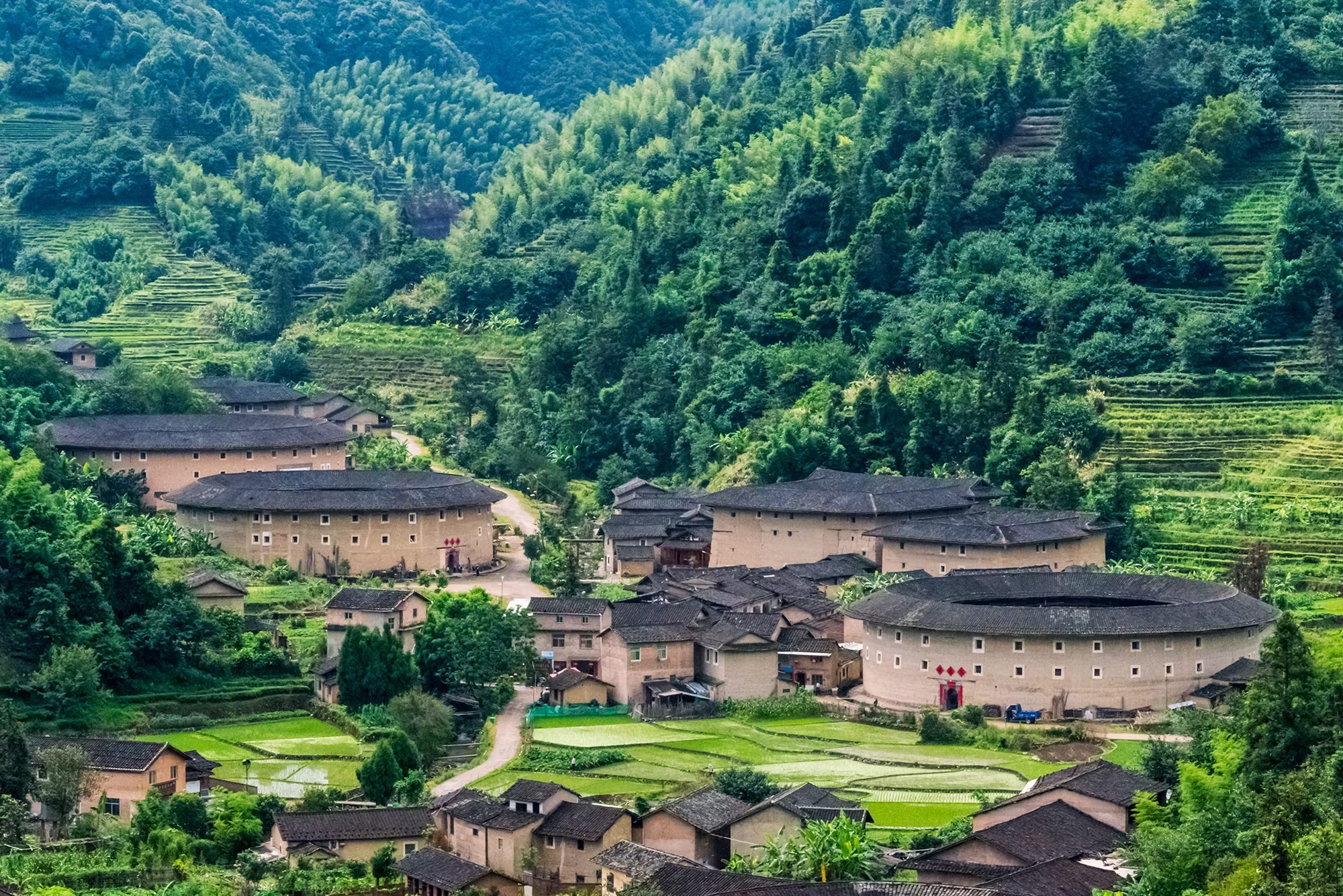
Fujian lies on the south-eastern coast of China, between Zhejiang to the north and Guangdong to the south, and directly across the Taiwan Strait from the island whose tea culture it largely shaped. The province is small by Chinese standards — about 121,000 square kilometres — but extraordinarily mountainous. Roughly 90 per cent of the land area is hills or mountains; the coastal plain is narrow and densely populated, and most of the agricultural land is terraced.
The climate is humid subtropical, warm and very wet. Annual rainfall in the tea-growing zones ranges from 1,500 to over 2,000 millimetres. Mist sits in the valleys for much of the year. Soils are acidic, often broken up by granite outcrops, and rich in mineral content where weathered volcanic rock is close to the surface. None of this is unusual for southern China; what is unusual is how much of Fujian's tea has been shaped by the very specific microclimates within it.
Fujian accounts for roughly a fifth of China's total tea output, but its share of premium tea is much higher. The province produces about a quarter of the country's oolong, almost all of its white tea, and a large fraction of its scented and specialty greens. The rest of the production is divided across four sub-regions, each with its own teas, cultivars, and traditions.
Wuyi: Where Oolong Was Invented
The Wuyi Mountains run along the northern edge of Fujian, on the border with Jiangxi. The range is a UNESCO World Heritage Site, a landscape of red sandstone cliffs, narrow valleys, and the slow Nine-Bend River that snakes between them. Tea has been grown here for more than a thousand years.
Two of those years matter especially. Some time in the late Ming or early Qing — the precise date is impossible to recover — the partial-oxidation process that defines oolong was first worked out in Wuyi, on the trees growing between the cliffs. The result was a category of tea unlike anything that came before: more complex than green, less heavy than black, with the floral and roasted notes that the rocks and the local cultivars seemed designed to produce. Da Hong Pao is the most famous of these Wuyi rock teas, but the category — generally called yan cha, "rock tea" — includes dozens of named varieties: Shui Xian, Rou Gui, Tie Luo Han, Bai Ji Guan, and many smaller cultivars that exist only in particular gorges.
The other crucial Wuyi invention is black tea itself. Lapsang Souchong, the smoke-dried tea from Tongmu village in the high northern part of the range, is by most accounts the first fully oxidised black tea ever made. The story is that during a period of military disruption in the 17th century, soldiers occupying the village forced producers to dry their tea quickly using pinewood smoke; the resulting tea fetched an unexpectedly good price among foreign traders, and the technique stuck. Whether the story is accurate or apocryphal, the dates align reasonably well with the appearance of black tea in European records, and Tongmu remains the only place in China where Lapsang Souchong is officially produced.
The Wuyi terroir is the source of the term yan yun — "rock rhyme" — which describes a particular mineral note found in tea grown directly between the cliffs, where the roots reach into mineral-rich crevices and the bushes rarely receive direct sunlight. It is a flavour that does not survive transplanting. A bush moved from Wuyi to a neighbouring valley five kilometres away makes recognisably different tea.
Anxi: The Tieguanyin Homeland
Two hundred and fifty kilometres south of Wuyi, in a quieter range of hills surrounding the city of Quanzhou, lies Anxi county. Anxi is to southern Fujian oolong what Wuyi is to northern: the heart of a category. The defining tea here is Tieguanyin, the "Iron Goddess of Mercy."
The Anxi style differs from Wuyi in almost every respect. Where Wuyi rock teas are heavily oxidised, deeply roasted, and dark-leaved, Anxi oolongs are typically lightly oxidised, lightly roasted, and tightly rolled into small green pellets. The flavour profile is correspondingly different: floral and creamy where Wuyi is mineral and roasted, suggestive of orchid and lilac where Wuyi is suggestive of cocoa and dried fruit.
This was not always the Anxi style. Before the 1990s, traditional Tieguanyin was a heavier, darker, more oxidised tea — closer in spirit to Wuyi rock tea than to its modern incarnation. The shift to the bright, floral, low-oxidation style happened gradually through the 1990s and 2000s, driven partly by Taiwanese influence (Taiwanese oolong producers had popularised a similar style) and partly by changing tastes among urban Chinese drinkers. The traditional roasted Tieguanyin still exists, but it is a specialist's tea now, and most modern drinkers know only the green version.
Anxi's geography supports a very different kind of cultivation from Wuyi. The hills here are gentler, the land easier to terrace, and the gardens larger. Anxi produces more tea by volume than Wuyi by a wide margin, and most of it is sold across China and abroad. A premium Wuyi rock tea is a rare object; a good Tieguanyin is something you can find without much trouble in any Chinese tea shop.
Fuding and Zhenghe: White Tea Country
Northeast of Wuyi, in the coastal county of Fuding, and inland in the smaller county of Zhenghe, is the part of Fujian that produces almost all of China's white tea. White tea has been made in the area for centuries, but the modern category — defined around the cultivars Fuding Da Bai (Big White) and Fuding Da Hao (Big Hao) — took its current shape in the 19th century, when these cultivars were systematically planted across the region.
The Da Bai cultivar is the foundation of the entire category. It produces unusually large, plump leaf buds covered in fine silver down, ideally suited to the minimal-processing approach that defines white tea. Silver Needle, the most refined of the white teas, is made entirely from the unopened buds of Da Bai or Da Hao bushes, picked over a two-week window in early spring and dried with almost no further intervention. The grades below it — Bai Mu Dan, Gong Mei, Shou Mei — use combinations of buds and young leaves from the same cultivars.
Fuding's coastal climate gives the tea a particular character: humid, salty air; cool nights; warm days. The proximity to the sea matters. Zhenghe sits further inland, at higher altitude; its white teas are generally fuller-bodied, slightly more robust, often described as more "fragrant" by Chinese tasters. The two counties argue, in a friendly way, about which produces the finer white tea. The argument has been going on for a century and shows no sign of ending.
The minimal processing required by white tea — withering and drying, almost nothing else — suits Fuding's climate well. There is no pan-firing, no rolling, no oxidation control beyond what air and time accomplish on their own. The category is, in some sense, the answer to what tea looks like when the producer barely intervenes. That answer evolved here, on the coast of north-eastern Fujian, because the local cultivars made it possible.
Fuzhou and Jasmine
Fuzhou, the capital of Fujian, sits at the mouth of the Min River, halfway down the coast. It is not a major tea-growing area itself, but it has been one of the most important tea-trading cities in China for centuries, and it is the historical centre of jasmine tea production.
Jasmine tea, as discussed elsewhere, is not a variety but a method: green tea, usually from elsewhere in Fujian, is scented with the blossoms of Jasminum sambac over multiple rounds during the summer bloom. Fuzhou's role is the scenting itself. The city sits in a coastal plain warm enough to support extensive jasmine cultivation, and the seasonal bloom — late June through September — has aligned for centuries with the supply of green tea from the inland mountains.
By the Ming dynasty, Fuzhou had developed industrial-scale scenting workshops, and the techniques refined here became the standard for the whole category. Premium jasmine teas are still produced in Fuzhou and the surrounding counties, scented up to nine times across the full bloom season. The city remains the place where the freshest jasmine flowers and the best Fujian green tea meet, in midsummer, in conditions that are difficult to replicate anywhere else.
The Fujian Paradox
One province, four canonical tea categories, four distinct sub-regional styles. No other tea region in the world has anything like this concentration. Yunnan has pu-erh and Dianhong. Zhejiang has Longjing and a handful of greens. Anhui has Keemun and Huangshan Maofeng. India has its black-tea regions. Japan has its green-tea regions. Each of these places does one or two things very well. Fujian does four things very well, in four different parts of the same province, using four different cultivar families and four largely unconnected processing traditions.
The simplest explanation is that Fujian's geography produced the conditions for tea innovation in a way that other regions did not. The mountains create a wide range of microclimates within short distances. The coast made trade easy and put producers in regular contact with overseas markets willing to pay for unusual teas. The cultivars are unusually diverse — Wuyi alone has hundreds of named tea-bush varieties, the result of centuries of selection within the small valleys. And the political stability of southern Fujian, relative to much of China during the late imperial period, allowed long traditions to develop without the ruptures that affected other tea regions.
Whatever the explanation, the result is that a comprehensive tour of Fujian — Wuyi for rock tea and the original black tea, Anxi for green oolong, Fuding and Zhenghe for white tea, Fuzhou for jasmine — would take you through more of the world's significant tea history than any equivalent journey anywhere else. Most tea drinkers, without knowing it, are drinking from this province most days.