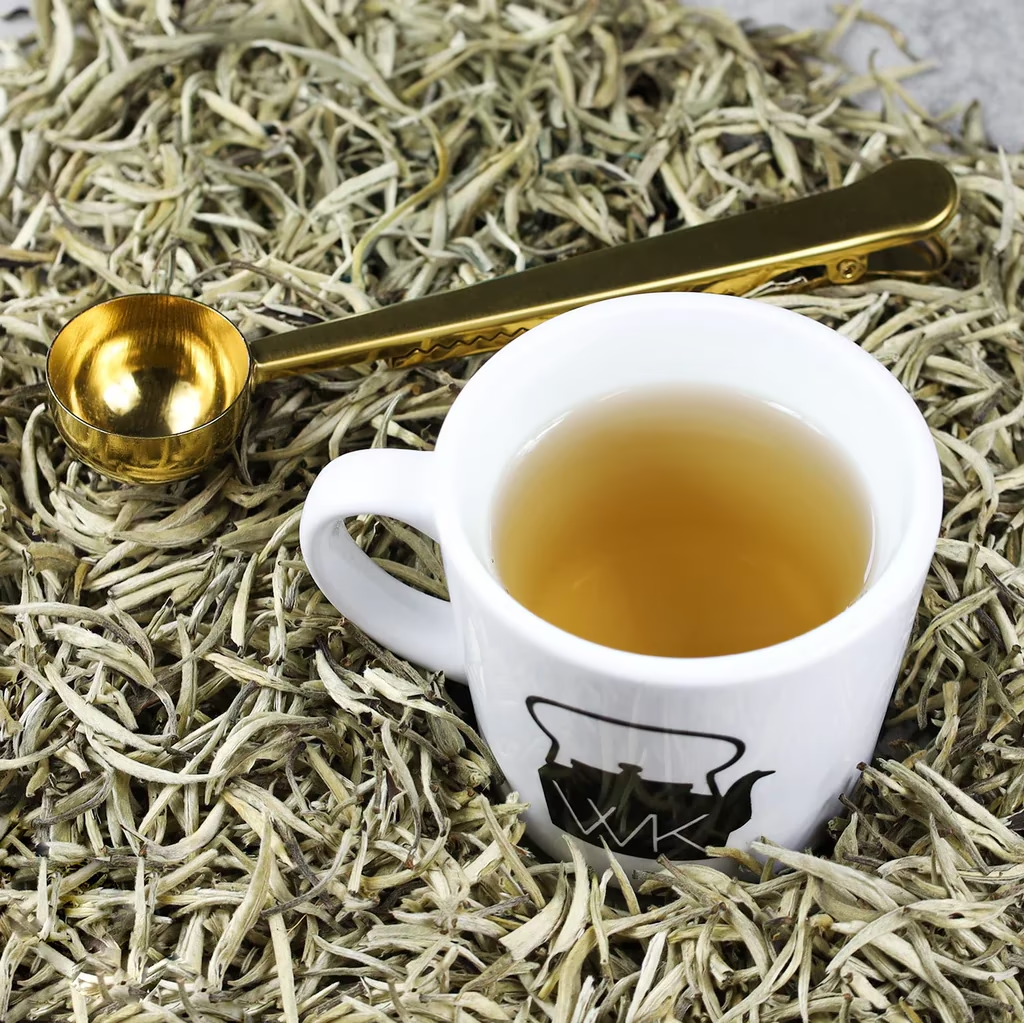
Silver Needle — Baihao Yinzhen in Mandarin, "white-hair silver needle" — is the finest white tea made, and in some years the finest tea of any category made in Fujian. It is made entirely of unopened leaf buds, each one covered in a fine silver down that catches the light. The dry tea looks almost metallic.
What goes into Silver Needle is as simple as tea processing gets, and what comes out is anything but. A well-made Silver Needle has a pale, almost colourless liquor, a faint sweetness of fresh melon and honey, and a clarity that most teas never approach. It is one of the quietest teas in the world, and one of the most particular.
Fujian and the Big White Cultivars
Silver Needle comes from Fujian province, specifically from two counties in the north: Fuding and Zhenghe. Fuding is closer to the coast, Zhenghe slightly inland; both produce Silver Needle, and specialists disagree about which is finer. Fuding Silver Needle is generally brighter and sweeter; Zhenghe is fuller-bodied, sometimes described as more fragrant.
The cultivars that make Silver Needle possible are Da Bai (Big White) and Da Hao (Big Hao). These are specific tea varietals with unusually large, plump buds and an exceptional amount of silvery down. Silver Needle cannot be made well from ordinary Camellia sinensis cultivars; the buds are too small and the down too sparse. Fujian's Da Bai and Da Hao bushes are what define the tea, as much as the processing does.
What It Takes to Pick
Silver Needle is picked only in early spring — a window of perhaps two weeks, usually in late March and early April, before the buds open into leaves. Only the unopened terminal bud is taken, one per stem. No leaves, no double buds, no damaged tips.
A skilled picker in Fuding harvests perhaps 500 grams of fresh buds in a day. Those fresh buds lose roughly three-quarters of their weight in drying. A kilogram of finished Silver Needle therefore represents about four kilograms of fresh material, which is a full day's work for eight to ten pickers. This is why even mid-quality Silver Needle is meaningfully more expensive than most teas, and why top-grade Silver Needle from well-regarded gardens can cost several times more than most people have ever paid for tea.
Weather matters enormously. A warm, dry early spring produces the best Silver Needle; a wet or cold one can compress the picking window to a few days, or produce buds that are smaller than the best grades require. Silver Needle is, in this sense, a vintage tea.
The Simplest Processing
Of all tea processing, white tea is the least interventionist, and Silver Needle is the least interventionist of all whites. The buds are picked, laid out in a thin layer on bamboo trays, and left to wither in open air under indirect sunlight or in a shaded, well-ventilated room for 36 to 72 hours. Then they are finished with a low-temperature drying — sometimes sun-drying alone, sometimes a gentle charcoal or low-temperature oven dry — to bring moisture down to a stable level.
There is no rolling. No pan-firing or steaming. No bruising. No shaping. The enzymes in the leaf are not halted sharply the way they are in green tea, but they are not encouraged either, as they are in oolong or black. The tea oxidises very slightly, almost incidentally, as the buds lose moisture.
The minimalism is the point. Almost anything else done to the tea would interfere with the character of the bud itself — the delicate sweetness, the honey note, the soft aroma of fresh hay. Silver Needle is a test of the raw material. Good buds make good Silver Needle. There is very little the maker can add.
What It Tastes Like
The liquor of a fresh Silver Needle is pale straw, sometimes almost colourless — so light that novice drinkers often think the tea has failed to brew. It has not; Silver Needle is simply paler than any other tea.
The aroma is faint but distinct: fresh hay, melon rind, a trace of honey, sometimes a note that tea writers describe as "cucumber" or "fresh grass after rain." The flavour is equally restrained — sweet, clean, with almost no astringency, a slightly creamy texture, and a long, subtle finish. A well-made Silver Needle can be drunk cup after cup without fatigue.
It is worth tasting Silver Needle against matcha to understand the range of what green-leaved teas can do. Matcha is concentrated, vivid, almost confrontational — the tea equivalent of a brass band. Silver Needle is the opposite: so quiet that you have to lean toward it to hear what it is saying. Both teas are made from young leaves and both are considered the refined summits of their categories, but they express refinement in opposite ways.
How to Brew It
Silver Needle wants cool water and patience. Around 80°C is the standard — boiling water scalds the delicate buds and produces a thin, slightly papery cup. A thermometer helps, but if you do not have one, boil the water and then wait two to three minutes before pouring.
Use more leaf than you expect. The buds are fluffy and take up volume: 5 grams of Silver Needle in a 150ml gaiwan looks like a lot, but the dry weight is the same as 2 grams of a dense rolled oolong. First infusion 30 to 60 seconds. Second infusion, longer — perhaps 90 seconds. Silver Needle will give four or five meaningful infusions, each one slightly different, before the buds give up.
A glass vessel is worth using at least once. Silver Needle is one of the few teas that is visually interesting to brew: the buds stand upright in the water, drift slowly to the bottom, rise again as bubbles form on them. Tea drinkers in China sometimes brew Silver Needle in a tall clear glass just for this.
Aged Silver Needle
Silver Needle has traditionally been drunk fresh — within a year or two of being made. Recently, though, Fuding producers have begun pressing and storing Silver Needle in the manner of aged pu-erh, and a small but real market for aged Silver Needle has emerged.
Aged Silver Needle is a different drink. The pale straw liquor deepens to gold. The fresh-melon note gives way to something heavier — dried apricot, honey, sometimes a hint of medicinal woodiness that aged white-tea drinkers value. The delicacy is mostly gone, replaced by richness.
Whether aged Silver Needle is better than fresh is a matter of taste. The traditional view is that fresh Silver Needle is the tea's proper form, and that aged versions trade away exactly the qualities that make the tea worth drinking. The newer view, increasingly held in Fuding itself, is that Silver Needle is simply a tea that changes with time, and that both the fresh and aged versions are legitimate expressions. On one thing everyone agrees: bad Silver Needle does not become good Silver Needle by sitting in a warehouse. Only the best teas are worth ageing.