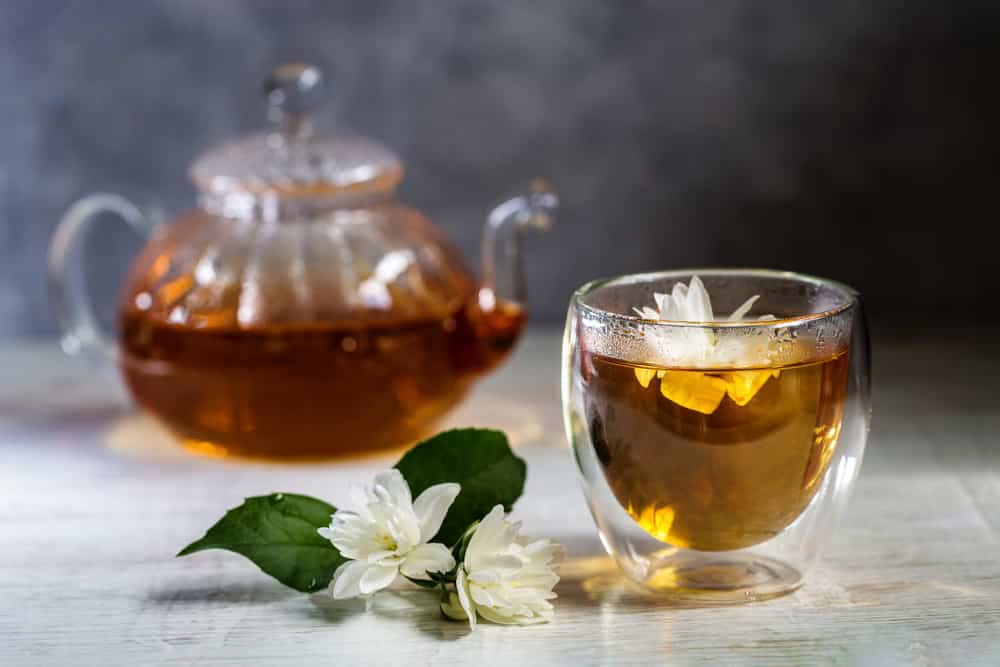
Jasmine tea is not a variety. The leaves in a tin of jasmine tea are almost always green tea — usually from Fujian province, sometimes white or lightly oxidized oolong. The jasmine is added afterward, not grown alongside the tea and not blended in any permanent sense. The scent is transferred from living flowers to dried leaves over a series of nights, and then the flowers are removed. What remains is tea that carries the memory of the blossom without any of the plant itself.
That process — patient, seasonal, labour-intensive — has been refined in Fujian for roughly a thousand years. Understanding it changes how jasmine tea reads: not as an additive or a flavouring but as a craft with a distinct logic, and one that produces an enormous range of quality depending on how carefully each step is executed.
Where It Comes From
Written records of jasmine-scented tea appear as early as the Song dynasty (960–1279 CE). The jasmine plant itself — Jasminum sambac, the species used in tea scenting, distinct from the common white jasmine of European gardens — arrived in southern China via Indian trade routes, probably during the Han dynasty, possibly earlier. Buddhist monasteries in Fujian were among the first to cultivate it; the flower's association with purity gave it ceremonial value before it had a culinary one.
By the Ming dynasty (1368–1644), Fuzhou — the capital of Fujian, a port city that handled much of China's maritime trade — had become the centre of jasmine tea production. The proximity of the Fujian tea mountains and the coastal jasmine gardens created a natural concentration of both materials. Imperial tribute records from the Ming and Qing courts mention jasmine-scented teas among the gifts sent from Fujian to Beijing. The long journey northward, which took weeks by boat and land, may have encouraged the development of more intensive scenting: a tea destined to spend weeks in transit needed an aroma robust enough to survive the journey.
The Tea That Gets Scented
The base matters as much as the flowers. A jasmine-scented tea is only as good as the tea underneath the scent — and a heavily scented tea can conceal a mediocre base in a way that makes quality assessment genuinely difficult.
Green tea is the standard base for a straightforward reason: its clean, relatively neutral character accepts jasmine aroma without competition. The most common cultivars used in Fuzhou are pan-fired greens harvested in spring. Some producers use a lightly oxidized base — closer to a pouchong — which gives the finished tea more body. A small number of premium jasmine teas are built on a white tea base, typically Silver Needle buds from Fujian; these are the most delicate and among the most expensive, because both the base tea and the scenting process are costly.
The base is harvested in spring — March or April — and then stored, carefully dried and sealed, until the jasmine blooms in midsummer. There is a gap of two to three months between harvest and scenting during which the tea must be kept at low humidity to prevent it from absorbing ambient odours. A base tea that has picked up mustiness or refrigerator notes during storage will carry those into the finished product regardless of how well it is subsequently scented.
The Process
Jasmine sambac flowers in Fujian from late June through September. The buds are harvested in the early morning, while they are still tightly closed — a closed bud contains the maximum concentration of aromatic oils. If picked open, much of the volatile compound benzyl acetate, the primary carrier of jasmine fragrance, will already have dissipated into the morning air.
After the harvest, the buds are spread in a cool, well-ventilated room and left through the day. As evening approaches and the temperature drops, the buds begin to open — jasmine is a night-blooming plant, and the opening is triggered by the cool air. By ten or eleven at night, the flowers are fully open and releasing fragrance at maximum intensity.
The scenting itself is simple in principle: dried tea leaves and open jasmine blossoms are layered together, the warmth of the flowers elevating the humidity slightly and driving the aromatic oils into the tea. The ratio is roughly one part flowers to three or four parts tea by weight. After six to ten hours — usually overnight, timed so the flowers can be removed before they begin to wilt and introduce unwanted vegetal notes — the flowers are separated from the leaves by sieving, and the tea is re-dried at low heat to remove the moisture the flowers brought.
This is one scenting round. For standard commercial jasmine green, two or three rounds are typical. Premium grades undergo five to seven rounds. The finest Silver Needle jasmine teas — produced in small quantities by a handful of Fujian workshops — receive nine rounds over the course of the entire jasmine season, from late June to September. Each round adds depth rather than simply volume; the later rounds operate on a base that has already absorbed several earlier layers, creating a complexity that a single intense scenting cannot replicate.
The seasonal constraint is absolute. Jasmine blooms for perhaps twelve weeks in Fujian's climate. A nine-round tea is scented across the full bloom period; the final rounds use the last flowers of the season, which some producers believe have a slightly different, richer character than the earlier ones.
What the Grades Look Like
Jasmine Silver Needle: the most expensive and delicate category. A white tea base of whole unopened buds, scented seven to nine times. Pale gold liquor, aroma that is floral without being perfumed, almost no astringency. The buds in the cup look like small furled cylinders; they do not unfurl dramatically.
Dragon Pearls, or Jasmine Pearls: a rolled tea of two buds and one young leaf, shaped into a small sphere. The rolling is done after the first or second scenting round and continues through subsequent rounds. The balls unfurl when brewed, which is most of the reason for the format — visually compelling, and the gradual opening does extend the release of aroma across the infusion. Quality varies enormously; a premium pearl uses a fresh spring green as the base and undergoes four or five rounds; a cheap one may use autumn leaf and a single scenting.
Standard loose jasmine green: the category most people encounter first, in tea shops and restaurants. Broken or needle-grade green tea, two to three scenting rounds. Perfectly drinkable, and in a good restaurant the base leaf is often higher quality than the price would suggest. Not a collector's tea but a functional one.
Authentic Scenting vs Synthetic
Most supermarket jasmine tea and a significant portion of restaurant jasmine tea is not naturally scented. It is produced by spraying dried tea leaves with synthetic jasmine flavouring — a compound that approximates benzyl acetate and a handful of other aromatics but lacks the organic complexity of a real flower.
The sensory differences are consistent enough to be useful once you know what to look for. Natural scenting produces an aroma that is cool, slightly green, and fresh — the jasmine sits over the tea rather than saturating it. On the second and third infusions, the floral note is quieter but still present; real scenting distributes the aroma through the leaf rather than coating the surface. Synthetic scenting is typically louder in the dry leaf than in the cup; the aroma is warmer and sweeter, more perfumed in the way of a cosmetics counter than a flower garden, and it diminishes sharply after the first brew.
Price is a reliable proxy. Multiple rounds of natural scenting require labour, seasonal timing, and a high-quality base — the flowers alone add significant cost. A naturally scented jasmine green from a named Fujian producer will cost more than a supermarket jasmine bag, not because the brand is prestigious but because the process is genuinely expensive. Anything sold in bulk at commodity pricing is almost certainly not naturally scented.
How to Brew It
Jasmine tea brews like the base tea it is made from. For the vast majority of jasmine teas — built on a green base — the same rule applies as for any green tea: water around 80°C, not boiling. The aromatic compounds that make jasmine tea worth drinking are volatile; boiling water drives them off before they reach the cup.
First infusion: 1–2 minutes for needle-grade and broken-leaf teas; 2–3 minutes for Dragon Pearls, which need the time to begin unfurling. The pale gold or greenish liquor should smell of the flower before you drink it — if the aroma is absent in the steam, the tea has either been over-brewed or is synthetic. A good naturally scented jasmine tea gives two or three substantial infusions; the first is typically the most floral, later ones more tea-forward.
Glass or white porcelain shows both the colour and the movement of the leaves as they open. There is no reason to use a Yixing clay pot for jasmine tea; the porous clay absorbs the floral compounds that are the whole point of the tea.