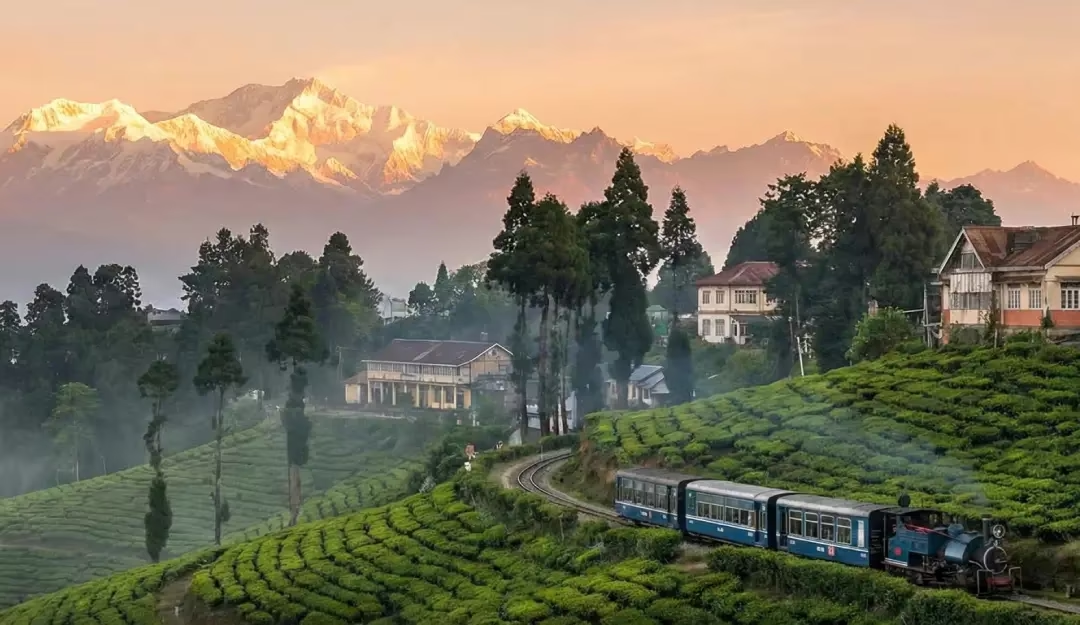
Darjeeling is the only tea region most British shoppers can name without prompting. The word does at least four jobs in English. It is a district in the Indian state of West Bengal. It is the tea grown in that district. It is a marketing nickname — the "Champagne of Teas" — that has stuck for more than a century. And it is a protected geographical appellation that, in theory, restricts the use of the word on a tin to leaves grown within 87 specific gardens. All four meanings overlap, none of them is quite stable, and the gap between them is where most of the interesting story lives.
The dedicated comparison with Assam already lives in another article. This one is about the place itself: how it ended up making tea, what shape its calendar takes, and why the same name on two boxes can mean very different things.
In the Foothills of the Himalayas
Darjeeling sits in the far north of West Bengal, in the narrow corridor of Indian land that bridges Nepal in the west and Bhutan in the east. The district is small — about 3,150 square kilometres — and almost entirely mountainous. Tea is grown here at altitudes ranging from roughly 600 metres in the lower valleys to 2,000 metres on the highest slopes, with most of the well-regarded gardens between 1,000 and 1,800 metres. The tea bushes grow on terraces cut into hillsides steep enough that pickers move along them sideways.
The climate is the point. Days are warm but rarely hot; nights are cool, and at the highest gardens cold enough to slow leaf growth almost to a halt during the winter. Mist rolls up the valleys most mornings. The soils are thin, acidic, and well drained. None of this is ideal for high-yield agriculture. All of it is unusually well suited to producing slow-grown leaves with concentrated, complex flavours.
The town of Darjeeling itself was developed by the British East India Company in the 1830s as a hill sanatorium — somewhere for officials to escape the heat of the Bengal plains. It became a tea capital almost by accident. The same cool, wet, elevated environment that made it pleasant for convalescing Englishmen turned out to be ideal for a kind of tea production that did not yet exist in India.
An Empire's Botanical Experiment
The Company began testing tea cultivation in Darjeeling in 1841, after a Scottish surgeon named Archibald Campbell planted seeds in his garden at Beechwood and watched them thrive. The first commercial gardens were laid out in the 1850s; by 1856 the Alubari Tea Garden had begun production, followed within a few years by Steinthal, Tukvar, and Makaibari. Most of the early planters were Scots — a pattern repeated across British India — and many of the family names that still appear on Darjeeling estates trace back to that first generation of garden owners.
The choice of plant material was unusual. By the 1850s the British were already producing tea in Assam, on the plains to the east, using the native large-leaved Camellia sinensis assamica. Logic suggested using the same plant in Darjeeling. Logic was wrong. The Chinese small-leaved variety, Camellia sinensis sinensis, smuggled out of Fujian by the botanist Robert Fortune in the 1840s, did far better at Darjeeling's altitude. The cooler temperatures suited it; the assamica plant, by contrast, struggled with the cold.
The result was that Darjeeling became — and remains — almost the only tea region in India that grows the Chinese plant rather than the local one. This is why a Darjeeling tastes nothing like an Assam, and why it is the only Indian black tea that bears any real resemblance to a Chinese one. The bushes themselves are Chinese, planted by Scotsmen, on land taken from Sikkim, in the foothills of the Himalayas. The tea inherits all of that.
The Four Harvests
Darjeeling's tea calendar is divided into four flushes — distinct harvest periods, each producing tea with a different character. Most other tea regions also flush, but Darjeeling is the region where the flushes are sold separately, named on the packaging, and treated as different products at different prices.
First flush runs from late February through April, depending on the garden's altitude. The bushes are coming out of winter dormancy; the new shoots are small, pale, and intensely concentrated. First flush Darjeeling is the one tea writers reach for superlatives about. Pale gold liquor, almost no body, a vegetal-floral aroma, sometimes a note that English tasters call "green" and Indian tasters call "fresh." It is short-lived — a first flush degrades noticeably within a year — and it is expensive. The very best lots from gardens like Castleton, Margaret's Hope, or Jungpana are auctioned at prices that compete with single-estate burgundies.
Second flush runs from May through June. The leaves are larger, more developed, and have spent longer on the bush; the tea has more body, deeper colour, and a fuller flavour. Most second flush carries the muscatel character — a distinctive note resembling muscat grapes, sometimes with a faint suggestion of dried fruit and bee-stung honey. The muscatel flavour, on which Darjeeling's whole reputation partly rests, is most associated with second flush. Many drinkers consider it the best-balanced of the four; first flush admirers consider it the only one that survives a long sea journey without losing its character.
Monsoon flush, from July through September, is the workhorse harvest. The tea is plentiful, dark, and ordinary. Most of it goes into blends or to the domestic Indian market. It is rarely sold under garden names abroad.
Autumn flush, in October and November, is the smallest and quietest. The leaves grow slowly again as temperatures fall; the resulting tea is darker than first flush but lighter than second, with a mature, slightly woody character that some drinkers prefer to either of the spring harvests. Autumn Darjeelings are an underrated category and often a good value.
The Appellation Problem
The "Champagne of Teas" nickname has been in circulation since the late 19th century, when British marketers reached for the most prestigious comparison they could think of. The analogy works on two levels. Like Champagne, Darjeeling commands a price disproportionate to its yield. Like Champagne, it claims a single small geographical origin and a name that producers elsewhere are not legally allowed to use.
That second claim is more recent and more fragile than the comparison suggests. In 2003, India's Tea Board secured Geographical Indication (GI) status for Darjeeling, restricting the name to tea produced within the 87 gardens listed in the registration. In 2011 the European Union recognised the GI as a Protected Geographical Indication, giving it the same legal standing as Champagne or Parma ham within EU markets. In theory, no tea sold in the United Kingdom or the EU can be called Darjeeling unless it originates from those gardens.
In practice, the system leaks. The Tea Board has long acknowledged that the volume of tea sold worldwide as "Darjeeling" exceeds the total annual production of the appellation by a wide margin — at one point estimated at three or four times. The most common form of dilution is the inclusion of Nepalese tea, grown across the border in the Ilam district, in similar terrain and from similar cultivars. Ilam tea is often genuinely good. It is not Darjeeling. The "100% Darjeeling" mark on a tin is an attempt to reassure buyers that the gap between label and contents has been closed; it has not entirely closed.
Periodic strikes and political instability in the Darjeeling district — most notably the long Gorkhaland agitation of 2017, which shut most gardens for three months — have repeatedly squeezed legitimate supply, raising the temptation to substitute. The market sorts itself somewhat through price. A Darjeeling sold cheaper than a comparable Ilam is almost certainly the Ilam.
What Good Darjeeling Tastes Like
The single most useful thing to know about Darjeeling, for someone coming to it from English Breakfast, is that it does not taste like a typical black tea. The liquor is pale — gold for first flush, amber for second, never the deep mahogany of an Assam or a Ceylon. The body is thin. The mouthfeel is closer to a white wine than to any other tea most British drinkers will have encountered. It does not work with milk, and good Darjeeling is rarely sweetened.
Brewed with attention — water around 90°C, three to four minutes, in a thin porcelain cup where the colour is visible — a first flush tastes light and almost ethereal: fresh grass, lily, a faint dusting of nutmeg, a clean dry finish. A good second flush is fuller, with the muscatel grape note carrying through to a long sweet-bitter aftertaste. Both teas reward a second infusion at slightly higher temperature; both lose their nuance if brewed too hot or too long.
Darjeeling is the closest thing Indian tea has to a connoisseur's category. Most of what is sold under the name in supermarkets is undistinguished — generic teabag blends that taste of black tea in a generic sense. The interesting Darjeelings are sold by garden, by flush, by year, sometimes by lot number. They are not cheap. They are also not Champagne, despite the nickname. They are the product of a small, contested, mountainous district that British colonisers planted with Chinese bushes in the wrong country and turned, almost in spite of themselves, into the most recognisable name in tea.