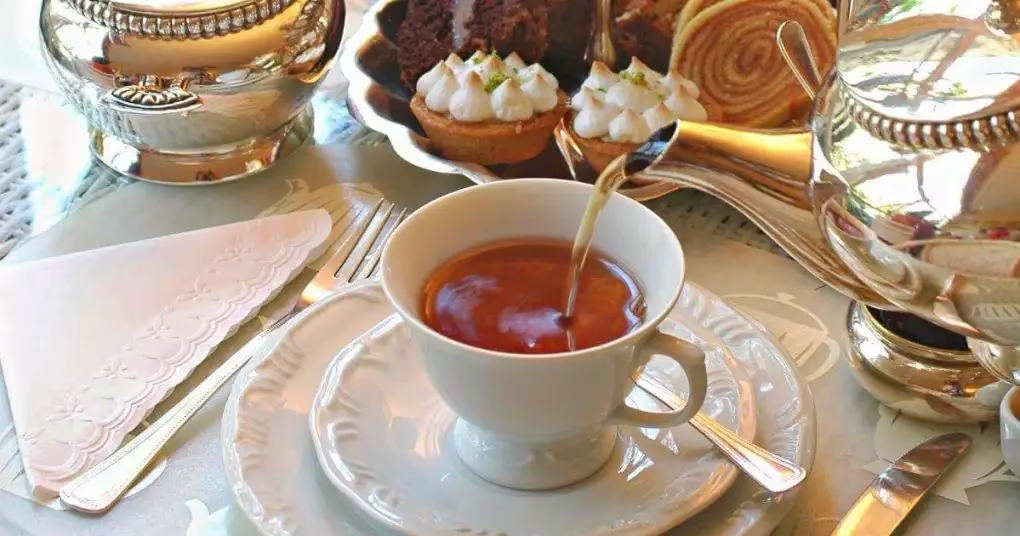
English Breakfast is not one tea but a category — a blend of several black teas, designed to produce a strong, coloured, dependable cup that takes milk without collapsing. It is the default morning drink for millions of people in Britain, Ireland, Australia, and much of the former Commonwealth, and it is the tea most Westerners mean when they simply say "tea."
The blend's reputation suggests an ancient pedigree. The reality is more recent, more contested, and in some respects more Scottish than English. The name "English Breakfast" was fixed in the 19th century, and the modern formula — mostly Assam with supporting teas — is a product of the 20th.
Scottish Beginnings
The most frequently cited origin traces the blend to Robert Drysdale, an Edinburgh tea merchant who in the 1890s is said to have marketed a strong black blend under the name "Breakfast" for customers who wanted a tea hearty enough for a full morning meal. An American version of the story credits Richard Davies, a New York grocer, with coining the name in 1843. Both are plausible; neither is documented clearly enough to resolve.
What matters more is that Queen Victoria is said to have encountered a version of the blend at Balmoral in the 1890s and taken the habit south. Whether she named it or simply popularised it, the royal association fixed it in the national imagination. By the early 1900s, "English Breakfast" was a fixed category sold by every major British tea merchant.
The blend has no protected name. Anyone can call anything English Breakfast. The result is that what you buy under the label varies considerably from one producer to another.
What's in It
A traditional English Breakfast contained three components: Assam for body and malt, Ceylon for brightness and colour, and Keemun for aromatic depth. This was the 19th-century formula, balanced and considered, and some high-end blends still follow it.
The modern mass-market version is simpler and stronger. Assam dominates — often as CTC (crush-tear-curl) pellets rather than leaf — with Ceylon as a lighter component, and increasingly Kenyan CTC as a cheap, reliable high-yielding addition. Keemun has largely disappeared from commodity blends, pushed out by cost. The result is punchier and less nuanced than the original, with a malty bluntness that stands up to a heavy pour of milk.
Supermarket tea bags are almost entirely CTC. Loose-leaf English Breakfast from a serious merchant is often still leaf-style and may specify origins — "Assam, Ceylon, Kenyan" or "Assam and Ceylon only" — on the packaging. The difference in cup is substantial.
What It's Supposed to Taste Like
A good English Breakfast pours deep mahogany, almost red-brown. The aroma is malty and faintly sweet, with a biscuit-like note from the Assam. In the mouth it is full, slightly astringent, with a brisk finish that the British call "brisk" and mean as praise — a clean edge that the tongue notices.
The blend was engineered for milk. Most black teas are dulled by dairy; English Breakfast is sharpened by it. The Assam malt character comes through the milk rather than being buried by it, and the slight astringency becomes a pleasant structure rather than a harsh edge. Drunk without milk, a heavy CTC English Breakfast can feel one-dimensional; with milk it comes into its own.
The Traditional Method
A pot, warmed with a splash of boiling water first, then emptied. One teaspoon of tea per cup plus one for the pot. Boiling water, full four minutes. Stirred once, strained into cups.
Milk goes in first or last — a debate that has occupied British households for two centuries. The "milk in first" camp argues that it prevents thermal shock to the milk proteins; the "tea in first" camp argues that it lets you judge the strength of the brew. Neither makes a large difference to a well-brewed tea. The Royal Society of Chemistry officially endorsed milk-first in 2003, which settled the question for nobody.
Modern tea bags brew faster and stronger — two to three minutes is enough. Anything longer and CTC tea turns bitter. If your bag is sitting in the cup after three minutes, you are not steeping it, you are stewing it.
The Wider Family
English Breakfast has siblings. Irish Breakfast is stronger still — almost entirely Assam, with a higher proportion of broken leaf, producing a deep red-black cup that can take milk by the tablespoon. It is the standard workman's tea of Ireland, and of much of the North American specialty market, where people seem to equate "Irish" with "strong."
Scottish Breakfast is a newer, more marketing-driven category — usually the most robust of the three, often with added Kenyan CTC, designed for the supposedly softer water of the Highlands. Afternoon Blend, by contrast, goes the other direction: lighter, more Ceylon-forward, meant to be drunk later in the day when a full Assam would be too heavy.
The differences between these blends are real but smaller than the marketing suggests. Any strong black blend drunk with milk at breakfast is, functionally, English Breakfast. The names describe variations on a theme — a theme the British standardised more than a century ago, and that now defines how most of the Anglophone world drinks tea.