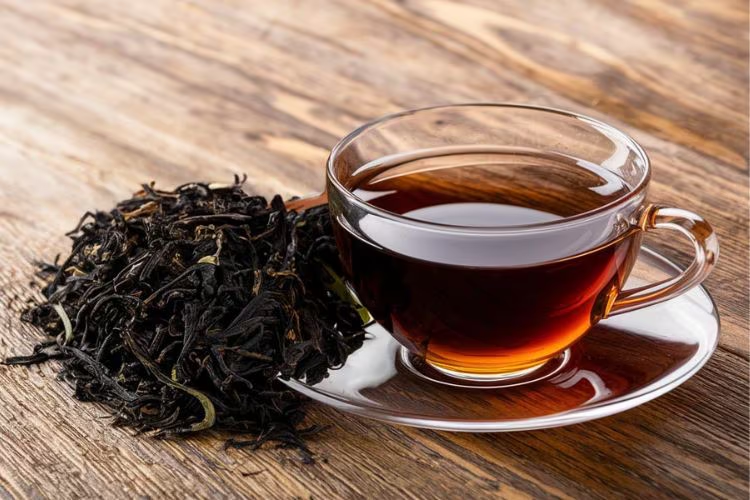
Black tea is fully oxidized tea. After picking, the leaves are withered, rolled to break open cell walls, and then left to oxidize completely — enzymes in the leaf convert compounds into the dark-coloured polyphenols that give black tea its characteristic colour and flavour.
It is the most-consumed tea in the world. Most of what is sold in tea bags in the West is black tea, often a blend of teas from Kenya and India. But reducing black tea to what is in an English breakfast bag is like reducing wine to box red. The category contains enormously varied teas with very different characters.
A Note on the Name
In China, this category is called hong cha — red tea. The Chinese name refers to the colour of the brewed tea (deep amber-red) rather than the dry leaves. The Western name "black tea" refers to the dark colour of the finished dry leaf.
To add to the confusion, when a Chinese speaker says "black tea" — hei cha — they usually mean pu-erh or another post-fermented dark tea, which is something else entirely. So a cup of what a British person calls black tea is, in China, red tea; and what the Chinese call black tea is what we would call fermented or aged tea.
Where It Comes From
India is the largest producer of black tea in the world by far. The two most famous Indian regions are Darjeeling and Assam, which produce teas as different from each other as any two teas in the same country can be. Darjeeling is grown at altitude in the Himalayan foothills and tastes thin, bright, and vinous. Assam is grown on the hot plains and tastes rich, malty, and full-bodied.
Sri Lanka (historically Ceylon) produces another significant portion of the world's black tea. Ceylon teas vary by elevation: low-grown teas are robust and full-bodied; high-grown teas are brighter and more delicate.
China, the birthplace of tea, produces some of the most refined black teas — though in much smaller quantity than India or Sri Lanka. Keemun from Anhui is one of the famous examples; Jin Jun Mei and Lapsang Souchong from Fujian are others. Chinese black teas tend to be more subtle and complex than Indian or Sri Lankan counterparts.
Kenya has become a major producer in the 20th century, mostly of crushed-tear-curl (CTC) tea used for blends and tea bags. African teas are strong, quick-brewing, and inexpensive.
Orthodox vs CTC
Black tea is made in two broad styles. Orthodox tea preserves the leaf more or less intact; CTC (Crush, Tear, Curl) pulverizes the leaf into small granules.
Orthodox tea is the traditional method. It produces whole-leaf tea that brews into a more complex, nuanced cup. Most high-quality black tea — Darjeeling, Keemun, Ceylon — is orthodox. It is more expensive to produce because the leaves must be handled carefully and not broken.
CTC tea is an industrial process invented in the 1930s. Leaves are chopped by machines into tiny granules, which oxidize quickly and brew into a strong, dark cup in seconds. Most tea bags use CTC. It is the dominant style for Assam and Kenyan production. CTC tea is not inherently bad — it is designed to be bold, milk-friendly, and cheap — but it has a limited flavour range compared to orthodox.
How to Brew Black Tea
Black tea is the most forgiving of the categories. It wants boiling water, 100°C. Infusion time depends on the tea: 2 to 3 minutes for most high-quality leaf teas, closer to 3 to 5 for CTC. Use about 3 grams of tea per 200ml of water.
Unlike green and delicate oolong teas, most black teas can take milk and sugar without being ruined. Whether they should is a matter of taste. Strong Assam and Ceylon hold up well with milk; delicate Darjeeling or Keemun are better drunk without.
Chinese black teas are often better gongfu-brewed — smaller vessel, higher leaf ratio, many short infusions. This will surprise anyone used to the Western approach. Try it with a good Keemun or Jin Jun Mei and compare to the same tea brewed in a standard teapot. The difference is substantial.