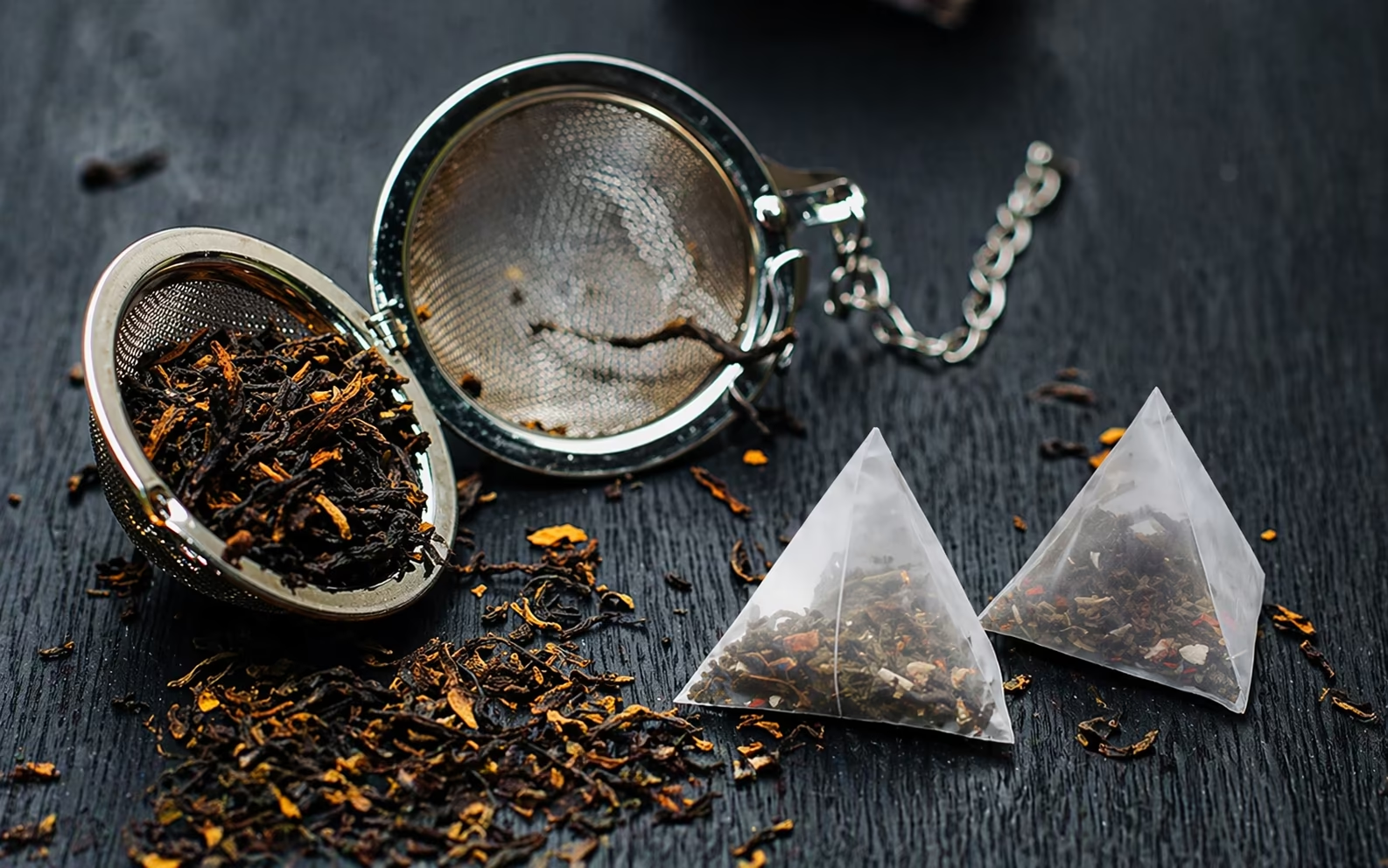
Both come from the same plant. Both are processed, dried, and shipped in similar ways. The difference between a tea bag and a tin of loose leaf tea is not, as it's sometimes described, a difference in kind — it's a difference in which part of the leaf ends up in your cup, and how much room that part has to behave like tea.
Understanding that distinction clarifies something that trips up most people making the switch from bags to loose leaf: the question is not only about quality, though quality is involved. It's about what tea actually is, what happens to it during processing, and what the bag was originally designed to do.
Tea Leaf Grades
The tea trade has always sorted leaves by size and condition, and the grading terminology reflects this. At the top: whole leaf grades, where the leaf is largely intact after processing. Below that: broken leaf, where the leaves have been cut or torn during manufacture, increasing their surface area. Then fannings — small fragments, typically 1–2 millimetres — and finally dust, the finest particles that sift to the bottom of the processing machinery.
Grading terminology varies by region and style. Indian and Sri Lankan black teas use abbreviations: OP (Orange Pekoe, a whole-leaf grade), BOP (Broken Orange Pekoe), BOPF (Broken Orange Pekoe Fannings), and so on. The word "pekoe" is a corruption of the Amoy dialect term for the white down on young tea buds and has nothing to do with orange as a flavour. Chinese teas tend to use descriptive names — "silver needle," "dragon well," "golden monkey" — that refer to the appearance or origin of the leaf rather than a grading code.
The two main processing approaches produce different grade distributions. Orthodox processing — the traditional method of withering, rolling, oxidizing, and drying whole leaves — preserves leaf integrity and produces a range from whole to broken. CTC processing (cut, tear, curl), developed in the 1930s for industrial-scale production, mechanically shreds the leaf into small, uniform pellets designed to brew quickly and consistently. CTC is the dominant method in the Assam region and in most of the tea that ends up in tea bags.
What Is Actually in a Tea Bag
The tea bag was invented by accident. Thomas Sullivan, a New York tea merchant, began sending samples to customers in small silk pouches around 1908 — intending them to be emptied, not steeped as-is. Customers found it easier to dip the pouch directly into hot water. Sullivan refined the idea; paper replaced silk; the industry adopted it.
What made the bag commercially useful was that it worked well with the cheapest, fastest-brewing grades: fannings and dust. Small particles have a very high surface area relative to their volume, which means they release colour and tannins almost immediately in hot water. A bag produces a strong, dark cup in two minutes without any knowledge of steeping times or leaf ratios. That was the point. The British tea-drinking public in the mid-20th century wanted a hot, strong cup quickly and reliably, and the tea bag delivered it.
The flavour trade-off is real but not straightforwardly about quality. Fannings and dust lose their aromatic volatile compounds faster after processing than whole leaves do, because the broken surfaces are exposed to air. A freshly opened box of good fannings can make a genuinely pleasant cup. The problem is that the same box, six months later, makes a dull one. The very efficiency of the format — high surface area, fast extraction — also accelerates degradation.
Why Loose Leaf Tastes Different
A whole or gently broken tea leaf contains oils, aromatic compounds, and structural complexity that extract gradually over multiple infusions. When the leaf is intact, the cell structure is preserved; flavour is released in layers rather than all at once. The first infusion of a good Longjing or a high-mountain oolong has a different character from the second, which is different again from the third.
Fannings and dust have already lost much of that layering. The rapid full extraction that makes bags so convenient also means there is less variation across the cup — the tea gives you everything at once, which is strong but one-dimensional. The volatiles that create aroma — the compounds responsible for the chestnut note in Longjing, the orchid in a good Tieguanyin — are present in smaller quantities and escape faster.
There is also the question of room. Whole leaves expand significantly when wetted, sometimes tripling in volume. A standard flat paper tea bag gives them almost no space to do this. Even if a bag contained the same quality leaf as a loose-leaf tin, packing it into a confined space limits how evenly the water can circulate around the leaf and how consistently the flavour extracts. This is why brewing temperature and time matter so much more with loose leaf — the leaves are responding to conditions rather than simply releasing a predetermined concentration.
Premium Bags and the Pyramid Format
The mesh pyramid bag, introduced by Brooke Bond in the mid-1990s and quickly adopted across the industry, addressed the most obvious structural problem: space. A pyramid bag holds roughly twice the volume of a flat bag, allows water to circulate around the leaf from multiple directions, and can accommodate broken or even whole-leaf tea without the flavour-suppressing compression of the flat format.
Some premium teas are now sold in pyramid bags with genuine whole-leaf content, and the difference from a flat bag is measurable. A pyramid bag of a decent Darjeeling first flush brewed at 90°C for two minutes produces something recognisably different from a supermarket flat-bag Darjeeling: more aroma, cleaner finish, more variation across the infusion.
The packaging language around premium bags is worth reading carefully. "Whole leaf" on a box of pyramid bags sometimes means intact leaves; it sometimes means "higher grade than our standard product," which might still be broken. "Single estate" is more reliable as a quality signal — it indicates a specific source rather than a commodity blend, regardless of leaf grade.
When to Use Each
Tea bags are not inferior for all purposes. For a strong, hot black tea with milk at seven in the morning — the role tea bags were designed for — they remain the most practical option. The flavour profile (strong, tannin-forward, consistent) suits the application. The same logic applies to travel, office kitchens, and anywhere that a 20-piece gongfu setup would be impractical.
Loose leaf becomes the only real option when the tea itself is the point. Gongfu brewing requires loose leaf — the gaiwan and small teapots of the Chinese tradition are designed around the expansion and multi-infusion potential of whole leaves. Aged teas — pu-erh, aged white teas — need room to breathe and release in stages. Single-origin teas with specific aromatic profiles, like a good Darjeeling muscatel or a Wuyi rock oolong, express those profiles fully only when the leaf can expand and the infusions can vary.
The practical starting point for anyone switching from bags to loose leaf is not to buy better bags but to get a simple infuser basket or a small gaiwan, buy a modest quantity of a whole-leaf tea from a single origin, and brew it at the correct temperature. The difference from a supermarket tea bag is not subtle. Whether that difference justifies the added attention is a question worth answering for yourself.