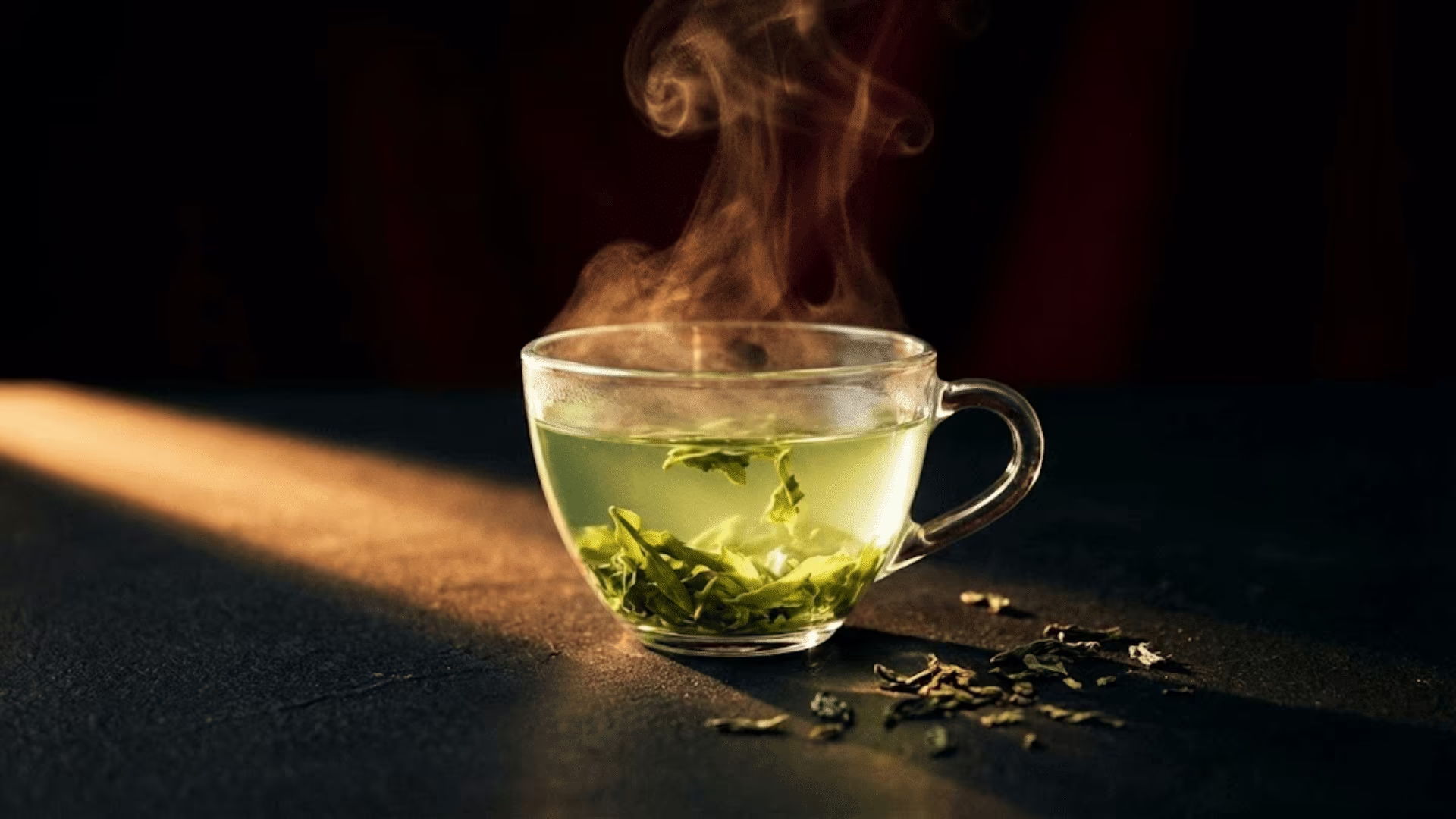
Most bad tea is good tea brewed incorrectly. The leaves are usually fine. The problem is the water — too hot, too cool, left in too long, pulled out too soon. Temperature and time control more than any other variable in tea preparation, and yet both are frequently ignored. The instructions on a tea tin, where they exist at all, tend to say something like "steep for 2–5 minutes," which is the equivalent of a recipe telling you to cook until done.
What follows is a reference for each major tea category: the temperatures that work, the times that don't ruin things, and brief explanations of why those numbers are what they are. The figures are starting points, not verdicts — every tea is slightly different, and the best brew time for a specific tea you own is found by tasting, not by chart.
Why Temperature Matters
Tea leaves contain hundreds of chemical compounds. Three groups matter most for how the brewed tea tastes. Catechins — the compounds responsible for bitterness and astringency — extract readily at high temperatures. L-theanine and other amino acids, which contribute sweetness and the umami-like depth that makes good tea satisfying, extract better at lower temperatures and more slowly. Tannins, which bind to proteins and create the dry, gripping sensation on the tongue, are also temperature-sensitive, though they matter less in unoxidized teas than in fully oxidized ones.
The practical consequence: delicate teas with a high proportion of amino acids to catechins — green teas, white teas — reward lower water temperatures. The sweetness and freshness come through; the bitterness is held back. Fully oxidized teas, where the catechins have been transformed by processing into other compounds, can take boiling water without becoming harsh. Understanding this one principle makes every other brewing decision easier.
Green Tea: 70–80°C, 1–3 Minutes
Green tea is the category most damaged by boiling water. The high amino acid content — the reason a good green tea can taste almost savoury — is overwhelmed when extracted at the same temperature as the catechins. What remains is flat and bitter in a way that has nothing to do with the tea's actual quality.
Most Chinese green teas do well between 75–80°C: Longjing, Bi Luo Chun, Anji Bai Cha. Japanese greens such as sencha sit in the same range. Gyokuro, the shaded Japanese green with the highest amino acid content of any tea, is brewed at 50–60°C — almost warm rather than hot. The rule of thumb: the more delicate and expensive the green tea, the lower the temperature it deserves. A one-minute first infusion at 75°C will reveal more of what a good green tea actually is than a three-minute steep at 95°C.
Time: 1–2 minutes for the first infusion using Western volumes; 30–45 seconds using the gongfu method with higher leaf-to-water ratios. Good green tea will give three or four infusions before it's spent.
White Tea: 75–85°C, 2–5 Minutes
White tea looks minimal — dried buds and leaves, nothing pan-fired or rolled — but it brews slowly. The tightly furled buds of a Silver Needle, for instance, release their flavor gradually; a one-minute steep produces almost nothing. The long infusion time is not optional.
Water between 75–85°C prevents the delicate floral and honeyed notes from being cooked away, while giving the leaves enough energy to open and release what they contain. A first infusion of 3–5 minutes is typical for Western-style brewing; in gongfu brewing, longer steeps of 1–2 minutes even in small vessels. Well-made white tea will reward four or five infusions, each one slightly different from the last — the later ones sometimes developing a warmth and sweetness absent in the first.
Oolong Tea: 85–100°C, 2–4 Minutes
Oolong covers a wide range — from lightly oxidized, floral Taiwanese high-mountain teas to heavily roasted Wuyi rock oolongs — and the temperature requirements shift accordingly. As a rule: the more oxidized and roasted the tea, the higher the temperature it needs.
Floral, lightly oxidized oolongs such as Taiwanese gaoshan or the green-style version of Tieguanyin work well at 85–90°C. The lighter roasting leaves aromatic compounds intact that boiling water would strip away. Heavily roasted oolongs — Da Hong Pao and other Wuyi rock teas, the traditional roasted Tieguanyin — want 95–100°C. The roasting has already transformed most of the volatile top notes; what's left requires real heat to extract properly.
In gongfu brewing, oolong is typically steeped in 20–30 second increments, adding a few seconds to each subsequent infusion. A quality rock oolong will still be producing interesting results at the eighth or ninth infusion.
Black Tea: 95–100°C, 3–5 Minutes
Fully oxidized black tea is the most forgiving of the major categories. The catechins present in green tea have been converted during oxidation into theaflavins and thearubigins — compounds that give black tea its characteristic reddish liquor and a different kind of astringency, one that resolves with milk rather than becoming bitter. Boiling water is not only acceptable but usually correct.
Darjeeling first-flush teas are a partial exception: lighter oxidation and delicate muscatel character benefit from water around 90–95°C rather than a full rolling boil. But a robust Assam, a Keemun, or a Ceylon intended for morning tea with milk: 100°C, 3–4 minutes, and the flavour is exactly what it's supposed to be.
Pu-erh: 100°C, Short Infusions
Pu-erh — both raw sheng and ripe shou — is brewed at full boiling temperature. The compressed leaves or loose maocha need the heat to open properly, and the fermented character of ripe pu-erh in particular emerges best from genuinely hot water. The handling that distinguishes pu-erh brewing from other categories is not the temperature but the infusion time.
A rinse of 5–10 seconds is typical before the first proper infusion — this wakes the compressed leaves and, in the case of aged teas, removes any mustiness from storage. The actual infusions run 10–20 seconds each for the first three or four steeps, lengthening gradually as the leaves tire. Done this way, a quality ripe pu-erh will produce eight to twelve drinkable infusions; an aged raw pu-erh, potentially more.
Judging Temperature Without a Thermometer
A variable-temperature kettle is the obvious solution, but not a necessary one. Boiling water cools at roughly 3–5°C per minute in a standard kettle or teapot, depending on the vessel, the ambient temperature, and whether it has a lid. The approximate translation:
If you remove the kettle from the heat just as it reaches a full boil and wait two to three minutes, the water will be around 85–90°C — correct for lightly oxidized oolongs and acceptable for white tea. Wait four to five minutes and you're at roughly 75–80°C, the range for most green teas. These are estimates, not measurements, but they're reliable enough for daily brewing.
Chinese tea tradition has names for the visual stages of water heating that pre-date thermometers by centuries. Xia yu, "shrimp eyes," describes tiny bubbles forming at the bottom of the vessel before the water is hot enough to brew anything — around 60–70°C. Xie yan, "crab eyes," are larger bubbles rising and breaking — roughly 80°C. A full rolling boil with white foam is sometimes called "old water," and in older texts was considered past its best for brewing because the dissolved oxygen has been driven off, leaving the water tasting flat. Whether that distinction matters in practice is debated; the temperature classifications are more useful.
Pouring boiling water from one vessel into another drops the temperature by roughly 5–8°C with each transfer. Two pours from kettle to pitcher to teapot brings boiling water to approximately 80–85°C, which covers most green and white teas without waiting.
Leaf-to-Water Ratio
Temperature and time are the main variables, but ratio shapes everything around them. Too few leaves and the tea will taste watery regardless of how carefully it's brewed; too many and the infusion will extract faster than expected, changing the time calculations above.
For Western-style brewing — one long infusion in a pot or mug — 2–3 grams of leaf per 200 millilitres of water is a reasonable baseline. The upper end (3 grams) works better for broken-leaf teas and black teas that need more mass to develop flavour; the lower end suits whole-leaf greens and whites that release quickly.
Gongfu brewing works with much higher ratios: typically 5–8 grams per 100 millilitres, depending on the tea. The high concentration means infusion times must be much shorter — which is why 20-second steeps make sense in a small gaiwan but would produce something undrinkable in a 500-millilitre teapot. The two approaches are not interchangeable; they're built around different assumptions about how the tea should reveal itself.