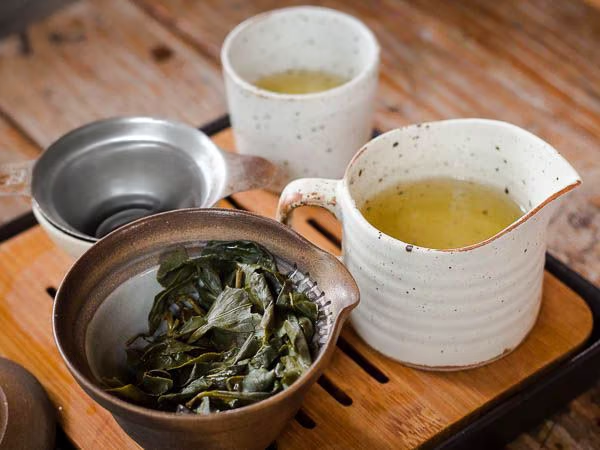
Oolong is the most varied of the six tea categories. A green tea, whatever its region, has a family resemblance to another green tea. Black teas share a certain fullness. White teas are identifiably white. But oolong is a category so broad that two oolongs can taste as different from each other as a green tea from a black tea.
What unites them is oxidation — not zero, not full, but somewhere in between. Where exactly in between depends on the tea. Some oolongs are oxidized only about 10 percent; they taste close to a green. Others are oxidized 80 percent; they taste close to a black. The middle, with all its possibilities, is where oolong lives.
How Oolong Is Made
The first few steps of oolong production look like any other tea: picking, withering. But then the leaves are bruised — tumbled or shaken, so the edges of the leaves are damaged. This releases enzymes that begin to oxidize the leaf, but only at the damaged spots.
The leaves are then left to oxidize for varying lengths of time. The tea master watches carefully. When the desired level of oxidation is reached, the leaves are pan-fired or heated to stop the process — the same kill-green step used for green tea.
After that, most oolongs are rolled and sometimes roasted. The rolling shapes the leaf (into balls, twists, or strips depending on the style) and damages more cell walls for better extraction during brewing. The roasting, when it happens, adds another layer — it can range from a very light finish to a dark, almost blackened flavour that dominates the finished tea.
The Two Homelands
Almost all great oolong comes from two places: Fujian province in southern China, and Taiwan. Each has its own tradition, its own famous teas, its own approach to processing.
Fujian is where oolong was invented. The Wuyi Mountains in the north of the province produce dark, rock-grown, heavily roasted oolongs known as yancha, rock tea. The Anxi region in southern Fujian produces lighter, often less-oxidized oolongs — the most famous is Tieguanyin.
Taiwan began producing tea seriously in the 19th century, using plants and techniques brought from Fujian. Over time it developed its own distinct style, focused on high-altitude production and lighter oxidation. Taiwanese high-mountain oolongs are among the most refined teas in the world.
The Flavour Range
At the light end of the category, you find teas like modern Tieguanyin or Taiwanese high-mountain — greenish, floral, often with orchid or lilac notes. Brewed, they produce a pale golden liquor and taste almost like a richer version of green tea.
In the middle sit teas like traditional Tieguanyin or Dong Ding — partly oxidized, partly roasted, with more body and a honeyed quality. These are the everyday oolongs.
At the dark end are the Wuyi rock teas: Da Hong Pao, Rou Gui, Shui Xian, and the rest. Heavily oxidized, heavily roasted, with deep mineral notes and sometimes an almost chocolatey sweetness. Brewed properly, they are among the most complex teas you can drink.
How to Brew Oolong
Oolong is the category that gongfu cha was invented for. The method — small vessel, high leaf-to-water ratio, many short infusions — is uniquely suited to oolongs because good oolong has so much to give. A decent Wuyi rock tea can give 10 or 15 distinct infusions, each different from the last. A Western-style single infusion flattens all that into one cup.
The starting point for most oolongs: about 5 grams of tea in a 100ml gaiwan, water at 95–100°C (close to boiling, unlike greens), first infusion around 10 seconds, subsequent ones lengthening slightly as the tea opens up.
The one clear rule: oolong wants hot water. Unlike green tea, which suffers at boiling temperatures, oolongs — especially the more oxidized and roasted ones — reward heat. The structure of the leaf is heavier, and it takes hotter water to coax the flavours out.